
When the Book Becomes the Blueprint
How ideas travel from page to policy — and what gets lost in the crossing.

Every consultant knows the moment. A CEO returns from a long flight. A book lands on the conference table. “We’re doing this,” they say. The team reads it over the weekend. By Monday it’s a strategic initiative. By quarter’s end it’s a budget line.
The book is usually good. The idea is usually real. The problem is the transfer — the moment when an idea built for one place gets picked up and used somewhere else, without asking whether it fits here, for these people, on this land.
This is a known failure in leadership work. It even has a name: the abdication of discernment. A leader reads something compelling, adopts it wholesale, and skips the harder work of asking what applies and what doesn’t.
It is also, it turns out, how Vermont has been building its laws.
But before we get to Vermont, there is something more fundamental to name. Every author who puts an idea into the world loses custody of it the moment it leaves the page. Wilson did not build the 30x30 policy apparatus. Gretchen Daily did not build the carbon credit markets now operating in Vermont forests. Klein and Thompson did not build the Abundance Network’s nine-figure billionaire funding operation. The authors birthed something real. What institutions built on top of it is a different thing — and the authors cannot control it from the outside.
That is not a criticism of the authors. It is a description of how ideas travel. And it is why the institutions that carry an idea bear the responsibility for the discernment the author cannot provide.
The Thirty-Thousand-Foot View
This is not a Vermont story at its origin.
It is a global story — three parallel pipelines, each built on books, each traveling through institutions until they landed in Vermont statute or Vermont policy. One says conserve half the land. One says nature is financial capital. One says build seven times as many homes. All three arrived carrying the authority of the institutions that passed them along. All three left their original assumptions — and the serious challenges to those assumptions — behind when they traveled.
To understand what happened, you have to go back further than the Statehouse. You have to go back to the books.
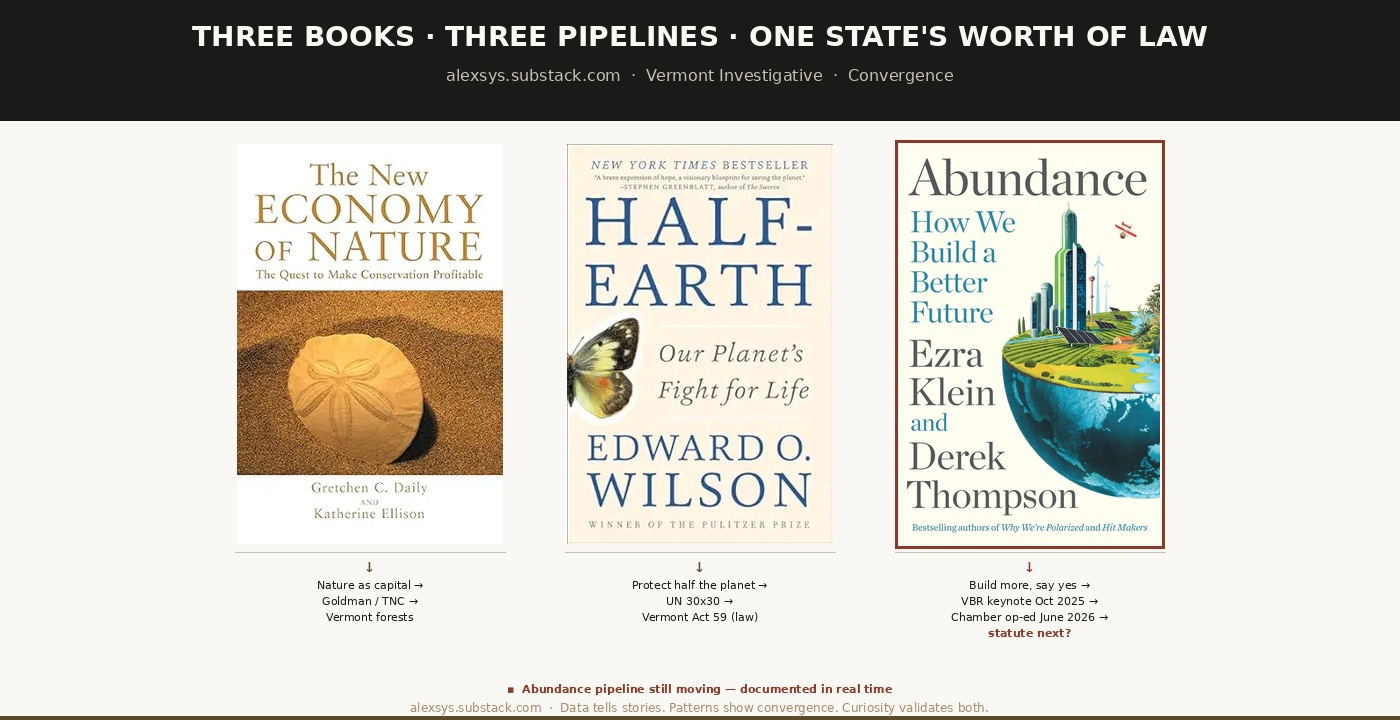
The Conservation Pipeline
In 2016, E.O. Wilson — one of the most celebrated biologists of the twentieth century — published Half-Earth: Our Planet’s Fight for Life. His argument was urgent and moral: humanity was driving a mass extinction, and the only way to stop it was to protect half the planet’s surface for non-human life. The idea was powerful. It was also, by the assessment of serious reviewers at the time of publication, a bold vision without a plan for how to make it real.
The Guardian praised Wilson’s diagnosis but said he provided “no detail of the measures needed to ensure his goal or what territories should be annexed or what funding mechanisms or agreements will be required to achieve his goal” — calling that “a pretty serious limitation.” The New Republic found “grand ambition without much to say.”[1,2]
Peer-reviewed analysis in the journal Oryx concluded the Half-Earth idea “does not get to the root of the problems it seeks to address, and would have serious negative impacts both on people — particularly poor people — and probably also on biodiversity.”[3] Social scientists at Wageningen University wrote in Aeon that Wilson’s vision, if acted on, “would entail forcibly herding a drastically reduced human population into increasingly crowded urban areas.”[4]
Indigenous peoples from the United States, Africa, Latin America, and Southeast Asia, speaking at the international body where the global 30x30 framework was formally adopted, signed a letter stating the target “as currently drafted will likely lead to permanent displacement and threaten the existence of Indigenous Peoples worldwide.”[5]
What traveled instead was the idea — and the institutional machinery that built a plan around it. Here is how that happened, step by step:
2016 Wilson publishes Half-Earth — a moral argument from a biologist. Urgent. Compelling. No implementation plan attached.
2021 The UN 2030 Agenda adopts 30x30 as a global political commitment with deadlines and money attached. President Biden signs the America the Beautiful executive order, making the US a formal participant and creating federal grant programs for states.
2022 Vermont Housing and Conservation Board applies for and receives a $1 million America the Beautiful Challenge grant to fund Vermont’s Act 59 conservation planning process.
2023 Vermont passes Act 59 — a legal requirement with statutory deadlines, making Vermont the first government in the world to enshrine a 50x50 conservation goal in law. Rep. Amy Sheldon, the bill's primary author and chair of the House Environment Committee, names Wilson's book as her inspiration — twice, in public, to two different audiences. She was not hiding the origin. She named it.
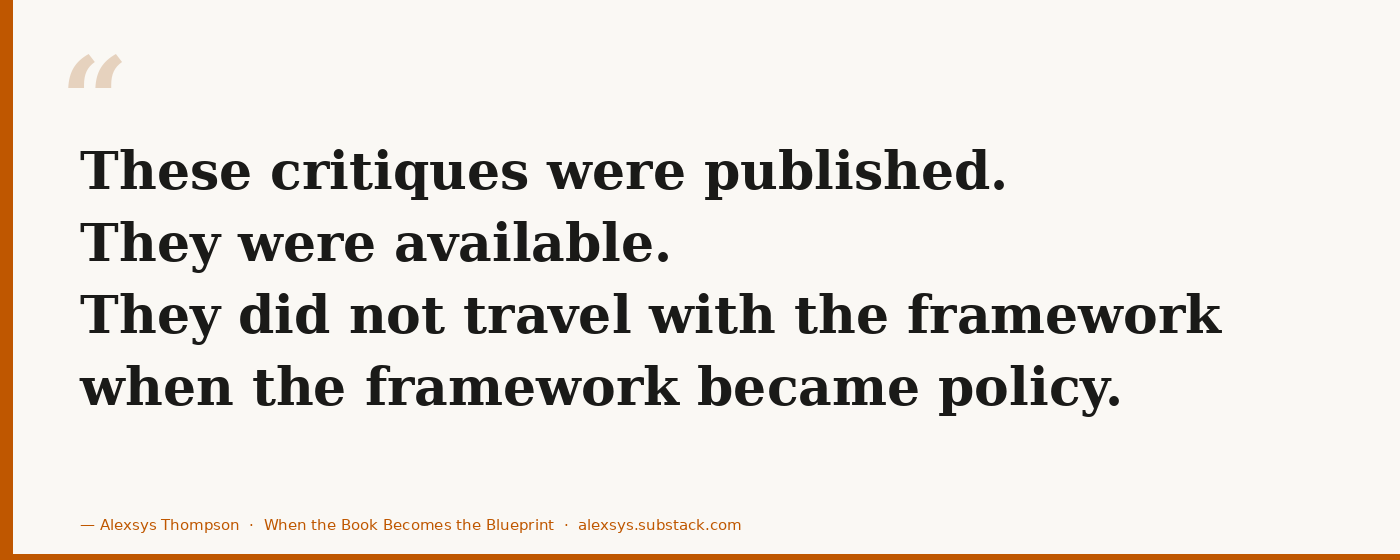
By the time an idea has traveled from a biologist’s moral argument through a United Nations framework through a federal executive order through a grant application through a statehouse committee, it arrives carrying the authority of every institution it passed through. The original vision — and the serious challenges to that vision — have been left at the gate.
Read the full documentation
Digging Into Act 59, Part 5 How Half-Earth traveled from Wilson’s book through the UN, a federal executive order, a $1 million grant, and into Vermont statute. Full primary source documentation.
Before Act 181, Vermont Had Act 59. Voluntary? Really? What the Current Use statute changes and the FPR data pipeline reveal about how “voluntary” conservation works in practice.
The Financial Pipeline
Running alongside the conservation pipeline, largely invisible to the people inside either one, was a second framework. In 2002, Gretchen Daily published The New Economy of Nature.[6] The argument: nature has economic value that can be measured, priced, and invested in. Conservation should not rely on moral argument alone — it should speak the language of capital.
The idea was serious and the problem it addressed was real. Conservation was chronically underfunded. Markets were destroying ecosystems with no accounting for what was being lost. Daily’s framework offered a path toward changing that.
Henry Paulson — then chairman of Goldman Sachs — read the book, gave it to Mark Tercek, and tasked him with building Goldman’s environmental markets division. Tercek later became CEO of The Nature Conservancy. The Natural Capital Project, co-founded by Daily, became a documented partner of UVM’s Gund Institute for Environment. The conservation finance machinery that grew from that lineage — carbon markets, biodiversity offsets, ecosystem services valuation — is now documented infrastructure in Vermont’s conservation network, operating on the same land the Current Use program was designed to protect. That full pipeline is documented in Digging Into Act 59, Part 5.
Daily did not design Vermont’s carbon credit market. She published a financial argument for valuing nature. What Goldman Sachs, TNC, and eventually Vermont’s conservation policy apparatus built on top of that argument is a different thing — and she cannot control it from the outside.
The Growth Pipeline
In March 2025, Ezra Klein and Derek Thompson published Abundance.[7] The core argument is genuinely compelling. One generation’s solutions become the next generation’s problems. Rules built for the 1970s can block the solutions we need for the 2020s. Our capacity to see problems has sharpened while our ability to solve them has diminished.
The harder question is a different one — the same question the book itself asks about old regulatory frameworks: does this solution fit this specific place, with these specific conditions, at this specific moment? Klein and Thompson ask it about 1970s-era rules. The same question applies to the Abundance framework itself, when it lands in a rural state losing population, with a housing market that is self-correcting through supply, where the numbers driving the mandate were never independently verified before they became law.
There is something else worth naming. When pressed publicly on whether the Abundance framework could itself produce unintended consequences, Thompson acknowledged the risk directly: "Could we see deregulation in various markets leading to outcomes that are undesirable? Yes." He then set it aside. Critics including David Dayen at the American Prospect documented that the book does not apply the same scrutiny to the deregulatory failures that produced 2008 that it applies to the regulatory failures of the 1970s.[8] Whatever qualifications exist inside the book, they did not travel with it when it arrived in Vermont. The bold claim traveled. The discernment stayed on the page. The framework the book proposed has since been adopted by an organized, well-funded movement whose internal documents — leaked and published in June 2026 — reveal goals that go considerably beyond what the book itself argues. The Abundance Network’s founder wrote in those documents that “small dollar internet fundraising makes politics dumber” and lamented the loss of what he called elite dominance over political gatekeeping.[9] Klein and Thompson did not write that. They published a book. What was built on top of it is a different thing.
The book became a #1 New York Times bestseller. By October 2025 — seven months after publication — Derek Thompson was keynoting the Vermont Business Roundtable’s annual breakfast. More than 400 business leaders, policymakers, and legislators attended. By June 2026, a six-organization op-ed co-signed by the Vermont Chamber of Commerce, Vermont Futures Project, Vermont Business Roundtable, Let’s Build Homes, Vermont Professionals of Color Network, and Lake Champlain Chamber stated Vermont needs 7,500 new homes annually — with no source cited, no endpoint year attached, and none of the questions the public record had already raised anywhere in sight.[10]
Seven months from keynote to statute-adjacent policy language. The book had become the blueprint. And the number carrying that blueprint kept moving. As of June 15, 2026, the same 36,000 by 2029 figure appears in WCAX coverage of U.S. Rep. Becca Balint's Community Housing Act — legislation seeking $500 billion in federal funding — attributed only to "state data," with no source named.[14]
What the Numbers Actually Show
The housing need in Vermont is real. The affordability pressure is real. The workforce shortfalls are real. What is also real — and documented — is that the specific number driving Vermont’s land use law did not survive scrutiny when scrutiny was applied. And that number was never independently verified before it became law.
Here is the chain of custody precisely: Leslie Black-Plumeau, Research and Community Relations Director at the Vermont Housing Finance Agency, published a blog post in January 2023 stating Vermont needed 30,000–40,000 new homes by 2030. She was the same researcher who had produced a figure of 5,800 homes needed just three years earlier — for the same agency, in the same planning cycle. One-seventh the number. VHFA’s own April 2023 legislative presentation flagged two of the projection’s five new components with question marks — “Is this really needed?” and “Exceptional growth?” — before the figure was embedded in statute.[11]
One piece of that number is worth naming plainly. The projection assumed Vermont needed thousands of homes sitting empty — not lived in, just vacant — to have a healthy market. That assumption came from a national average designed for big cities where people move in and out constantly. Vermont’s own history showed something much lower was normal here. The gap between those two benchmarks added more than 11,000 units to the final figure. Nobody challenged that assumption publicly before it became law.
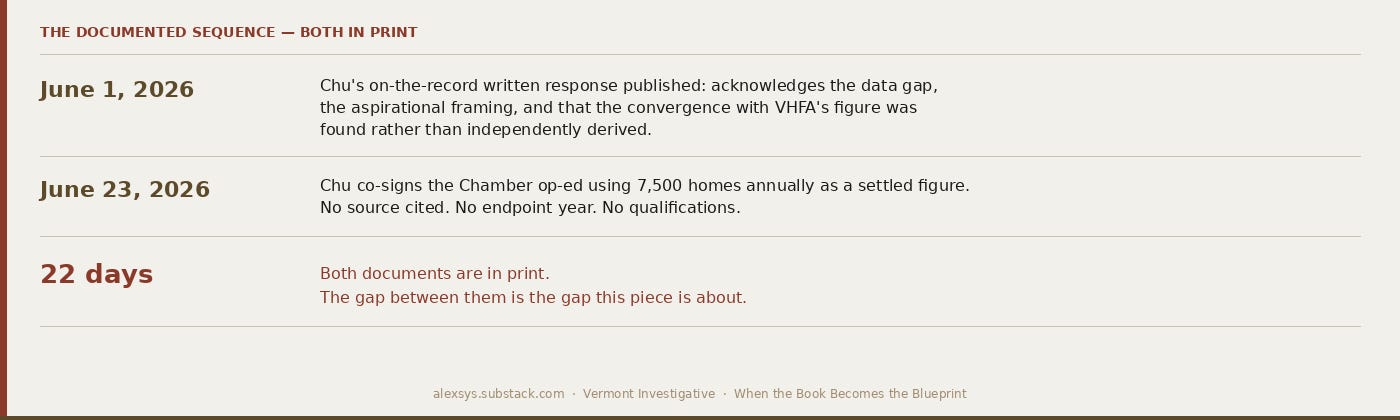
Vermont Futures Project did not generate an independent housing figure. Executive Director Kevin Chu confirmed this on the record in May 2026: Vermont Futures Project reviewed VHFA’s number, found the scale consistent with their own workforce analysis, and incorporated it. That is adoption, not validation. When two organizations arrive at the same number, it looks like two independent checks on the math. But if the second organization found the first one’s number and said “that fits what we already thought,” that is not a check. That is an echo.[12]
The aspirational framing is how the numbers were sold publicly. The statutory embedding is what actually happened to them. The 40,000 figure started as a VHFA blog post. Vermont Futures Project called their plan aspirational. But the number traveled into the HOME Act, into Act 181, into regional planning targets distributed to every Vermont town — where it became a legal requirement towns must incorporate. Aspirational at the source. A legal requirement at the destination. Nobody reconciled the two publicly.
The documented sequence — both in print
Meanwhile the market is telling a different story from the same data. Chittenden County’s rental vacancy rate reached 3.3% in June 2026 — approaching the 5% benchmark that generated more than 11,000 units of the 40,000 figure — through new construction alone, with rents softening and landlords competing for tenants. Statewide housing inventory is up 17.7% year over year. Average days on market: 68, rising. Vermont is the only state losing population from both natural change and net migration.[13] The planning targets embedded in law have not been publicly revised.
The same dataset tells two different stories depending on who is holding it and which data points they foreground. That is not a coincidence. That is the mechanism.
Read the full documentation
Vermont’s Moving Target: How a Housing Number Grew Seven Times in Three Years The full methodology comparison. Same agency, same researcher, one-seventh the number three years earlier. Every component documented from primary sources.
How a Number Becomes Policy: The Circular Logic Behind Vermont’s Housing Targets Kevin Chu’s full on-the-record response. What Vermont Futures Project reviewed, what they found, and what they acknowledged about the data gap.
The Discernment Question
Wilson was a serious scientist. Daily is a serious economist. Klein and Thompson are serious journalists. The books are real. The problems they identify are real. This piece is not arguing otherwise.
The question is what happened between the page and the policy.
Discernment is the practice of asking: what in here applies to my situation, what doesn’t, and what could go wrong if I get that wrong? It is slower than inspiration. It is less satisfying than a bold target. It requires sitting with the critics alongside the vision, and asking whether the challenges to an idea traveled as far as the idea itself.
In the CEO-on-the-plane situation, the cost of skipping discernment is a bad quarter, a failed initiative, a reorganization. The framework gets retired when the results don’t come.
In law, the cost is different. The targets get embedded in statute. The maps get drawn. The permits get required or exempted based on coordinates that came from a framework that came from a plan that came from a book that came from a moral provocation that was never designed to be a mandate.
Vermont is specific ground. It has a specific history, a specific ecology, a specific economy, a specific demographic reality. It has multi-generational families on land their great-grandparents cleared. It has a housing stock where 17% is seasonal by design. It has a population that was declining before the pandemic and is declining again now. It has conservation land that generations of landowners have stewarded voluntarily — land that now finds itself mapped into frameworks designed somewhere else.
The frameworks that arrived here — from conservation biology, from ecological economics, from national media journalism — were built somewhere else, for somewhere else’s problems. Some of what they carry applies here. Some does not.
The work of figuring out which is which does not appear in the public record. Whether it happened elsewhere, in rooms this series could not see, is an open question the record cannot answer. What the record can answer is this: it did not happen in public. And in a democracy, public is where it counts.

One more thing. The pattern this piece documents does not stop at books or policy. It applies to every powerful framework that arrives pre-packaged with authority — including the tools we now use to think, write, and govern. The question is always the same: whose thinking is this, and have you done yours? Discernment is not a soft skill. It is a survival skill. An idea adopted without it — however compelling, however credentialed, however well-intentioned at the source — will eventually become the thing it was trying to solve.
That work has a name. It is called discernment. And the record — across three books, three pipelines, and one state’s worth of law — shows it did not happen where it needed to.
The full series — Vermont Investigative
No One Is Coming to Save Rural Vermont — Because the Plan Is to Empty ItHow Act 181 connects to global frameworks and what the convergence means for rural communities.
Vermont’s Act 181: The Process Was the PoisonWhat the stakeholder process record shows — and what the chair of the committee that built the law confirmed.
Before Act 181, Vermont Had Act 59. Voluntary? Really?The Current Use statute changes, the FPR data pipeline, and what “voluntary” conservation means in practice.
Digging Into Act 59, Part 5The full pipeline from Wilson’s Half-Earth to Vermont statute, including the $1 million federal grant and the America the Beautiful connection.
Vermont’s Moving Target: How a Housing Number Grew Seven Times in Three YearsThe full methodology comparison — 5,800 to 40,000, same agency, same researcher, three years apart.
How a Number Becomes Policy: The Circular Logic Behind Vermont’s Housing TargetsKevin Chu’s full on-the-record response and what Vermont Futures Project acknowledged about the data gap.
The Book a Foundation Wrote About ItselfThe Lintilhac Foundation’s Catalysts for Change — what the book reveals about how influence moves through Vermont’s policy network.
Primary Sources & Citations
The Guardian, review of Half-Earth by E.O. Wilson. E.O. Wilson Biodiversity Foundation archive. eowilsonfoundation.org
Jedediah Purdy, review of Half-Earth, The New Republic, April 2016. Via Wikipedia entry on Half-Earth. en.wikipedia.org
Büscher, B. et al., “Half-Earth or Whole Earth?” Oryx, Cambridge University Press, 2016. cambridge.org
Fletcher, R. & Büscher, B., “Why E.O. Wilson is wrong about how to save the Earth,” Aeon. aeon.co
Project Expedite Justice et al., open letter on 30x30 target, COP15, December 2022. projectexpeditejustice.org
Daily, G., The New Economy of Nature, Island Press, 2002. Pipeline documented in: Alexsys Thompson, “Digging Into Act 59, Part 5,” Vermont Investigative, May 12, 2026. alexsys.substack.com
Klein, E. & Thompson, D., Abundance, Avid Reader Press / Simon & Schuster, March 18, 2025.
David Dayen, “The Last Abundance Agenda,” The American Prospect, April 1, 2025. Documents Thompson’s on-the-record concession in a public debate. prospect.org
Dylan Gyauch-Lewis, “New Documents Detail Nine-Figure, Silicon Valley–Funded Abundance Movement,” The American Prospect, June 12, 2026. prospect.org
Chu, K. et al., “Vermont Chamber: Vermont is in Trouble,” op-ed, Vermont Daily Chronicle / Manchester Journal / Vermont Business Magazine, June 23, 2026. Housing figure sourced in Vermont Economic Action Plan, Vermont Futures Project, p. 30, to VHFA Statewide Housing Needs Assessment.
Black-Plumeau, L., VHFA, “30,000–40,000 More Vermont Homes Needed by 2030,” January 25, 2023. Collins, M., VHFA, presentation to Vermont House Energy and Environment Committee, April 12, 2023. Vermont public legislative record. Documented in: Alexsys Thompson, “Vermont’s Moving Target,” Vermont Investigative, April 17, 2026. alexsys.substack.com
Chu, K., Executive Director, Vermont Futures Project, written on-the-record response, May 2026. Published in: Alexsys Thompson, “How a Number Becomes Policy,” Vermont Investigative, June 1, 2026. alexsys.substack.com
Redfin, Vermont Housing Market, May 2026. redfin.com. Chittenden County vacancy: Vermont Public / VTDigger, Carly Berlin, June 9, 2026. Population data: VTDigger, May 29, 2026. vtdigger.org
WCAX, "Balint pitches Vermont housing model for national rollout," June 15, 2026. wcax.com/2026/06/15/balint-pitches-vermont-housing-model-national-rollout/ The figure is attributed to "state data" with no primary source named
If you find yourself reading, learning, or citing this work please consider supporting it with a Substack subscription or Ko-fi.
Such crucial work, Lexy. Thank you!
Brilliant work. Citation of sources and timelines give it credibility. Your voice is needed.
This is what happens in a one party- one mentality place like Vermont politics. Everyone goes along to get a long as a survival technique because jobs are so scarce.
You call it discernment. Others call it vetting. The question I always asked myself when I was in business and presented with a proposition was - what’s the worst thing that can happen? Where will this lead eventually? These questions needed to be asked and answered but were not because they were all on the bandwagon with a hand in the cookie jar.