
Digging Into Act 59, Part 5
Two books. One moral argument. One market mechanism. Vermont made both into law.

In June 2023, Vermont became the first government in the world to enshrine a 50 by 50 conservation goal in statute. Thirty percent of Vermont’s landscape conserved by 2030. Fifty percent by 2050.
Rep. Amy Sheldon — who holds a master’s degree in natural resource planning from the University of Vermont, chairs the House Environment Committee, and was the lead sponsor of Act 59 — told the Sierra Club in August 2023 exactly where the idea came from:
“I’m very familiar with E.O. Wilson’s Half-Earth, and it just seemed like Vermont was really well situated to move forward in a meaningful way with the goal of 30 by 30 and 50 by 50.”— Rep. Amy Sheldon, Sierra Club, August 2023
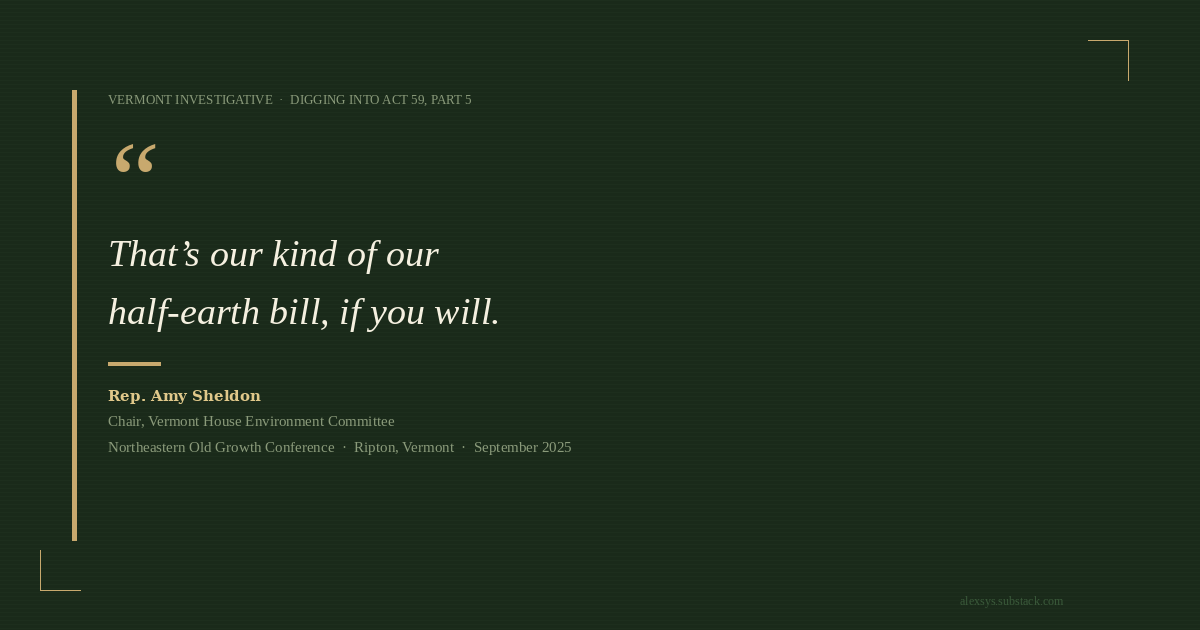
She said it again at the Northeastern Old Growth Conference in September 2025, describing Act 59 to an audience of scientists and conservationists as “our kind of our half-earth bill, if you will.”
She was not speaking casually either time. She was naming the origin.
This piece traces that origin — from two books to a United Nations framework to a federal executive order to a state legislature to a $1 million federal grant that funded the planning process now delivering a Conservation Plan to Vermont’s legislature by June 30, 2026. Every link in that chain is documented in the public record.
The idea: Edward O. Wilson, 2016
Edward Osborne Wilson spent his career at Harvard University studying ants, ecosystems, and the architecture of biological diversity. He won two Pulitzer Prizes. He published more than thirty books. He died in December 2021 at the age of 92.
In 2016, he published Half-Earth: Our Planet’s Fight for Life — the final volume of a trilogy that began with The Social Conquest of Earth (2012) and The Meaning of Human Existence (2014). Its argument was direct: humanity must dedicate fully half the surface of the Earth to nature, or face the mass extinction of species, including potentially our own.
At that moment, approximately 15 percent of global land area was protected in some form.
Wilson’s proposal was not a plan. It was a number. Fifty percent. And a name: Half-Earth. It is worth noting that the 50 percent figure was not derived from a precise scientific calculation — it was a moral argument calibrated to match the scale of the problem. Conservation biologist Stuart Pimm of Duke University and others argued in peer-reviewed work that protecting large, largely untouched temperate landscapes would do relatively little for global biodiversity, because most of the world’s species are in the tropics, already fragmented. A 2016 review in Science called the book an “evidence-rich plea” — the ecological urgency is real, but the specific number is an aspiration, not a calculated threshold. The E.O. Wilson Biodiversity Foundation worked to translate that aspiration into policy targets that governments could adopt. The stepping stone was clear: if 50 percent is the destination, 30 percent by 2030 is the first waypoint. 30x30.
The science dissent: where the numbers break down
The 50 percent figure was not the only number without a hard scientific foundation. The 30x30 target that became the interim global goal has the same problem. The key paper proposing it as an interim milestone — Dinerstein et al., 2019, published in Science Advances — framed 30x30 as a stepping stone toward 50x50, not as a threshold derived from species-protection modeling. Canada’s own Deputy Minister of Fisheries and Oceans acknowledged in a parliamentary hearing that the 30x30 target is “not a number derived in science.”
Stuart Pimm of Duke University, one of the world’s leading extinction scientists, published a peer-reviewed paper in Science Advances in 2018 that cut directly to the problem. His conclusion: “Just protecting Earth’s wilderness will not be sufficient to conserve most of its species; quality, not overall size, matters.” Governments, Pimm found, tend to protect areas that are remote, cold, or arid — areas that hold relatively few species. Protecting half of the world’s large wilderness areas, he wrote, “will not protect many more species than at present.” For plants, 85 percent of species occur entirely within just over a third of the Earth’s land surface — carefully optimized by geography, not by round numbers.
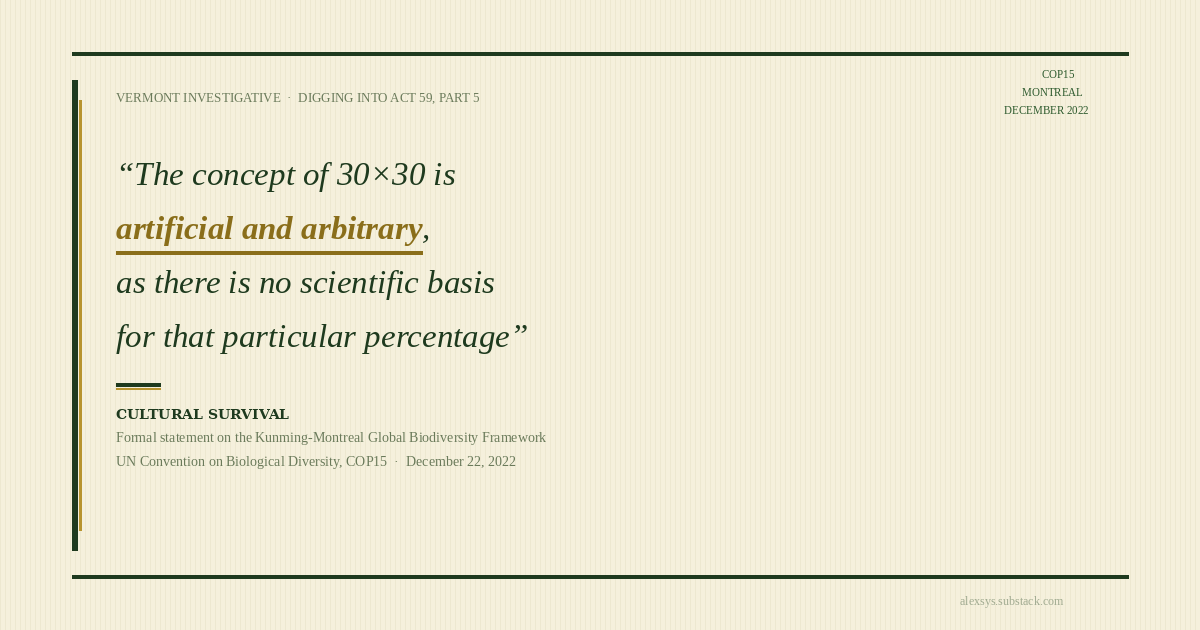
The framework also drew formal opposition from Indigenous communities worldwide. At COP15, Indigenous peoples from the United States, Africa, Latin America, and Southeast Asia signed a letter to the UN Convention on Biological Diversity stating that the 30x30 target “will likely lead to permanent displacement and threaten the existence of Indigenous Peoples worldwide.” Cultural Survival, in its formal COP15 statement, said directly: “The concept of 30x30 is artificial and arbitrary, as there is no scientific basis for that particular percentage of land in that particular period of time, and historically, conservation schemes have resulted in fortress conservation, harassment, and displacement of Indigenous communities.” The model of excluding people from land to protect it — documented in forced displacements, extrajudicial killings, and property destruction across ten protected areas worldwide — is what critics call “fortress conservation.”
Vermont’s Act 59 process did not fully incorporate Indigenous representation. The Phase I Inventory Report identified Indigenous representation as a gap not fully addressed in Phase I — documented in VHCB’s own published report.
Guilt, capital, and the confessional
The ecological grief underneath all of this is real. Wilson documented genuine loss — species disappearing, ecosystems fragmenting, a natural world diminished by industrial civilization’s appetites. People looked at what had been done and felt the weight of it.
Religion has always known what to do with that weight. Confession. Penance. Absolution. The promise that acknowledgment of sin, paired with the right ritual and the right payment, restores the relationship between the penitent and what is sacred.
Every carbon credit purchase is a visit to the confessional — return, do it again.
What Paulson’s Financing Nature report did — in language worth reading carefully — was build the price list for the confessional. The report states directly that philanthropy is how you distribute profits, but investing is how you generate them. Conservation funded by guilt and goodwill alone cannot scale. Private capital requires returns. So the question the report set out to answer was not how do we protect nature but how do we make protecting nature investable.
The answer: biodiversity offsets, carbon markets, natural capital valuation, ecosystem services pricing. Put a dollar value on the forest. Create a mechanism where destroying habitat here purchases a credit from someone conserving habitat there. The guilt becomes a transaction. And the number — 50 percent, 30 percent — gives the market a target to sell against. Without the number, there is no urgency. Without urgency, there is no premium.
The confessional has a price list. Vermont’s statute is one of the items on it.
The money: Henry Paulson, TNC, and the financing gap
Before the 30x30 target could move from aspiration to policy, someone had to make the financial case. That work was done by a coalition anchored by a former Goldman Sachs CEO who also chaired the board of The Nature Conservancy.
Henry M. Paulson Jr. served as the 74th Secretary of the U.S. Treasury under President George W. Bush. Before entering government, he spent 32 years at Goldman Sachs, serving as Chairman and CEO. He has also served as Chairman of the Board of Directors of The Nature Conservancy and Co-Chairman of TNC’s Asia/Pacific Council — documented on TNC’s own website. TNC Vermont lobbied for Act 59, contributed staff to Vermont Conservation Design, and is named as a lead implementer in Vermont’s draft Conservation Plan — each of those facts documented in prior installments of this series.
The person Paulson tapped to build Goldman’s environmental strategy was Mark Tercek, a 24-year Goldman veteran. The book that catalyzed the work: Gretchen Daily’s The New Economy of Nature: The Quest to Make Conservation Profitable, published in 2002. Tercek writes on his own Substack that Paulson gave him Daily’s book when he put him in charge of Goldman’s early environmental efforts in 2005. “It made sense for a Wall Street environmentalist like me to be attracted to this investment-oriented approach to protecting nature,” Tercek wrote. Daily, a biology professor at Stanford and co-founder of the Natural Capital Project, became what Tercek has called his “intellectual godparent.” In 2008, Tercek left Goldman to become CEO of The Nature Conservancy — the organization Paulson chaired — where he served for 11 years. The Natural Capital Project, which Daily co-founded, is a documented partner of UVM’s Gund Institute for Environment — the research institute housed in the same Rubenstein School where Rep. Sheldon earned her master’s degree in natural resource planning.
Daily and Wilson were working in parallel intellectual traditions, not a single lineage. Wilson was a conservation biologist making a moral argument about species survival — how much land must we protect to save life on Earth. Daily was an ecological economist asking a different question — what is nature worth in financial terms, and who will pay for it. Two separate traditions. Two different answers to two different questions. Both landed in the same Vermont statute.
In September 2020, the Paulson Institute co-published Financing Nature: Closing the Global Biodiversity Financing Gap with The Nature Conservancy and the Cornell Atkinson Center for Sustainability. TNC’s Andrew Deutz was a lead author. The report was launched at a public event headlined by Paulson and TNC CEO Jennifer Morris.
The report’s finding was stark: the global economy was directing between $124 billion and $143 billion annually toward biodiversity conservation. Reversing biodiversity loss by 2030 would require between $722 billion and $967 billion per year. The gap — approximately $711 billion annually — was large but, the report argued, not insurmountable. It laid out nine financial and policy mechanisms to close it, including harmful subsidy reform, biodiversity offsets, investment risk management, and private capital mobilization. The report was explicitly designed to inform the negotiations at COP15.
The framework: Kunming-Montreal, December 2022
Nearly 200 nations gathered in Montreal in December 2022 and adopted the Kunming-Montreal Global Biodiversity Framework. Target 3 of that framework — known globally as 30x30 — committed signatories to protecting 30 percent of terrestrial, inland water, and coastal and marine areas by 2030.
The E.O. Wilson Biodiversity Foundation was present at COP15, explicitly advocating for the agreement. In a public statement following adoption, the Foundation described the Kunming-Montreal Agreement as “an important step to Half-Earth.” The Foundation’s board chairman stated: “The late E.O. Wilson helped set us on this path to conserve sufficient land and water to protect nature. We honor his legacy by taking an important step to Half-Earth with this agreement on 30x30.”
TNC co-developed the implementation guide for Target 3 with the IUCN World Commission on Protected Areas and WWF, supported by the Global Environment Facility. The Kunming-Montreal Framework is not binding on the United States — the US is one of the few nations that has not ratified the Convention on Biological Diversity. What the US had instead was an executive order.
The federal infrastructure: Biden’s executive order and America the Beautiful
On January 27, 2021 — one week into his presidency — President Biden signed Executive Order 14008, directing federal agencies to pursue a 30x30 goal for the United States. The America the Beautiful initiative operationalized that commitment, creating a competitive federal grant program through the National Fish and Wildlife Foundation — a quasi-governmental entity chartered by Congress in 1984 — called the America the Beautiful Challenge.
The America the Beautiful Challenge funded conservation planning projects across 46 states in 2023. One of its grants — $1 million — went to the Vermont Housing and Conservation Board to fund Phase II of Vermont’s Act 59 conservation planning process. VHCB project manager Trey Martin confirmed the grant was on pace to be fully spent by June 30, 2026 — the same date the Conservation Plan is due to the legislature. In a January 2026 hearing before the House Environment Committee, Martin said Act 59 had been “a really good galvanizer” for VHCB’s conservation work.
Vermont’s application was competitive for a reason. The 2023 challenge received 456 pre-proposals representing $885 million in requests nationwide. Vermont had something almost no other applicant possessed: a statute. Act 59 had just passed, making Vermont the only government in the world with a 50x50 conservation goal enshrined in law, a mandatory planning requirement, and a statutory deadline. NFWF’s criteria explicitly prioritized projects that implement existing conservation plans. Vermont’s statutory mandate — including the one-year deadline — made its application uniquely concrete among 456 competitors.
The federal money created by Biden’s executive order is funding the planning process Vermont built to implement the law that Rep. Sheldon called Vermont’s “half-earth bill.”
The legislative infrastructure: NCEL and the one-year deadline
The National Caucus of Environmental Legislators is a national organization that works with state legislators to develop and advance environmental policy. NCEL’s own website documents the relationship: “Upon working with NCEL staff to identify land and water conservation policy models that had been effective in other states, Vermont State Representative Amy Sheldon sponsored the Community Resilience and Biodiversity Protection Act (H.126).”
Sheldon is quoted on NCEL’s page: “Facilitating connections among policymakers, via Zoom and in person, NCEL allows us to share and learn from one another while embracing our differences. It’s critical, as we set goals for conserving and restoring our lands and waters for future generations, that no matter the approach each state takes to achieving those goals, biodiversity remains the focus.”
NCEL provided draft bill language, talking points, and example management plans. The one-year statutory inventory deadline — the compressed timeline that drove Vermont’s planning process into outside contractors and working groups built around existing conservation organizations — was in the bill NCEL helped draft. Vermont’s Conservation Plan Is Being Written, Part XV of this series, documented that process and its costs in full.
The academic infrastructure: UVM, the Gund Institute, and Vermont Conservation Design
Rep. Sheldon holds a master’s degree in natural resource planning from the University of Vermont’s Rubenstein School of Environment and Natural Resources — the same school that houses the Gund Institute for Environment.
The Gund Institute was founded in 1991 as the Institute for Ecological Economics and moved to UVM’s Rubenstein School in 2002. Its documented partners include The Nature Conservancy, the Natural Capital Project, USDA, EPA, and state agencies. Its director Taylor Ricketts came from the World Wildlife Fund’s Conservation Science Program and is co-founder of the Natural Capital Project — itself a partnership between Stanford University, the University of Minnesota, the Chinese Academy of Sciences, The Nature Conservancy, the Stockholm Resilience Center, and the World Wildlife Fund.
Vermont Conservation Design — the science framework embedded three times in Vermont’s Act 59 statute and used to build the Future Land Use Map’s Rural Conservation designations — was built by state scientists at Vermont Fish and Wildlife and the Department of Forests, Parks and Recreation, funded by U.S. Fish and Wildlife Service State Wildlife Grants. TNC’s Dan Farrell and Rose Paul contributed to Part 2 workgroups, documented in the VCD Part 2 technical report. Vermont Land Trust is named as a partner in VCD’s development, documented in UVM’s Rubenstein School summary of VCD. The organizations whose staff contributed to building it are among those now named as lead implementers in the Conservation Plan built on it.
At the Northeastern Old Growth Conference in September 2025, Sheldon also confirmed on the record that Jamey Fidel — Vice President of Audubon Vermont and a registered lobbyist — worked alongside her on the foundational legislation that preceded Act 59: “I’d be remiss if I didn’t give a shout out to Jamie Fidel who really worked on that before I got there and with me all through it and we got it across the finish line.” Audubon Vermont is a member of the Staying Connected Initiative. TNC is SCI’s primary fiscal sponsor. SCI is named as a legislative finding in Act 59’s statute.
The federal floor drops out
On his first day back in office in January 2025, President Trump signed Executive Order 14154, “Unleashing American Energy,” which formally rescinded the Biden administration’s 30x30 commitment. Interior Secretary Doug Burgum followed with Secretarial Order 3418 in February 2025, rescinding Biden-era climate and conservation priorities. The Land and Water Conservation Fund — one of the primary federal mechanisms for state conservation funding — had funds diverted. 30x30 as a federal goal is, as one conservation analyst put it in February 2025, “effectively over at the federal level in the United States.”
Vermont State Senator Rebecca White — co-chair of the Vermont Climate Solutions Caucus and a supporter of Act 59 — stated on the record: “I was expecting with federal support there would be money and support for planning and local implementation, and even the purchase of property.” That support is gone.
The $1 million America the Beautiful Challenge grant that funded Vermont’s Phase II planning process was awarded and spent under the Biden framework. VHCB confirmed it will be fully spent by June 30, 2026 — the same date the Conservation Plan is due. The federal infrastructure that made that grant possible no longer exists. Vermont built its conservation planning process around a federal commitment that a subsequent administration rescinded.
The chain, complete
Here is what the public record shows, each link sourced to a primary document:
E.O. Wilson names the 50x50 goal in Half-Earth: Our Planet’s Fight for Life, 2016 — Liveright/W.W. Norton
Gretchen Daily publishes The New Economy of Nature, making the financial case for investing in conservation — Island Press, 2002
Henry Paulson, Chairman of Goldman Sachs and TNC’s board, gives Daily’s book to Mark Tercek and tasks him with building Goldman’s environmental markets division — 2005
Tercek leaves Goldman to become TNC CEO; Paulson chairs TNC’s board — 2008
Henry Paulson, former TNC Board Chairman, co-publishes Financing Nature with TNC and Cornell, designing policy mechanisms to inform COP15 — Paulson Institute, September 2020
President Biden signs Executive Order 14008 directing federal agencies toward 30x30; America the Beautiful Challenge creates federal grant infrastructure — January 2021
Nearly 200 nations adopt the Kunming-Montreal Global Biodiversity Framework, enshrining 30x30 as Target 3 — COP15, December 2022
NCEL works with Rep. Sheldon to develop Act 59, including the one-year inventory deadline — documented on NCEL’s website, ncelenviro.org
Vermont passes Act 59 in June 2023, becoming the first government in the world to enshrine a 50x50 goal in statute — Act 59 statutory text, legislature.vermont.gov
Sheldon tells the Sierra Club: “I’m very familiar with E.O. Wilson’s Half-Earth, and it just seemed like Vermont was really well situated to move forward in a meaningful way with the goal of 30 by 30 and 50 by 50” — Sierra Club, August 2023
VHCB contracts with Nature for Justice for Phase I and Future iQ for Phase II, funded in part by the America the Beautiful Challenge grant — confirmed by VHCB General Counsel Elizabeth Egan, May 6, 2026
Sheldon describes Act 59 as “our kind of our half-earth bill, if you will” at the Northeastern Old Growth Conference — Ripton, Vermont, September 17–20, 2025
President Trump signs Executive Order 14154 on Day One of his second term, formally rescinding the US 30x30 commitment — January 2025
Vermont Conservation Plan due to the legislature: June 30, 2026
What this piece does and does not do
This piece documents a chain of public record — from two books to a United Nations framework to a federal executive order to a national legislative support network to a Vermont statute to a planning process now concluding. No link in this chain requires inference. Every link points to a primary document.
This piece does not argue that wildlife connectivity is unimportant. It does not argue that Vermont’s landscape does not need protection. E.O. Wilson’s ecological concerns were real. The biodiversity crisis he documented is real. The organizations involved in this work have genuine conservation records.
What the public record documents is structure: where the idea came from, who built the financial case for it, who designed the policy mechanisms, who carried it to state legislatures, who lobbied for it in Vermont, and who is now implementing it.
Rep. Sheldon named it herself. Vermont’s half-earth bill.
These are yours to know. Vermont Investigative will be here with you.
If you have documents or firsthand knowledge relevant to any of these questions, contact me at alexsys.substack.com
Support this work at ko-fi.com/alexsysthompson
Primary Sources
NFWF, America the Beautiful Challenge 2023 grant announcement, November 2023 — nfwf.org
Executive Order 14154, “Unleashing American Energy,” January 20, 2025 — federalregister.gov
Center for Western Priorities, “From Disavowal to Delivery,” January 2026 — westernpriorities.org
Vermont State Senator Rebecca White, on record — Context/Thomson Reuters Foundation, November 2025
Vermont Conservation Design Summary Report, February 2018 — vtfishandwildlife.com
Vermont Conservation Design Part 2: Natural Communities and Habitats, March 2018 — vtfishandwildlife.com
Vermont Conservation Design development summary — UVM Rubenstein School, uvm.edu
Mark Tercek, “The 10 Best Books on Nature and the Environment,” Substack/Medium, 2021 — marktercek.com
Mark Tercek biography and Goldman Sachs Environmental Markets Group — philanthropy.com, August 2008; ecosystemmarketplace.com, August 2008
Gretchen Daily, The New Economy of Nature: The Quest to Make Conservation Profitable, Island Press, 2002
Stanford Magazine, “The Environment and the Bottom Line” — stanfordmag.org
Natural Capital Project partnerships — naturalcapitalproject.stanford.edu
Pimm, Stuart L.; Jenkins, Clinton N.; Li, Binbin V. “How to protect half of Earth to ensure it protects sufficient biodiversity.” Science Advances, 4(8), eaat2616, August 29, 2018 — doi: 10.1126/sciadv.aat2616
Dinerstein et al. “A Global Deal for Nature: Guiding Principles, Milestones, and Targets.” Science Advances, 5(4), eaaw2869, 2019 — doi: 10.1126/sciadv.aaw2869
Cultural Survival, formal statement on COP15 decisions, December 2022 — culturalsurvival.org/news/cultural-survivals-statement-regarding-cop15-decisions
Project Expedite Justice, Indigenous Peoples’ letter to CBD Executive Secretary, COP15, December 2022 — projectexpeditejustice.org
Canada Deputy Minister of Fisheries and Oceans, parliamentary hearing testimony on 30x30 scientific basis, October 2025
Half-Earth: Our Planet’s Fight for Life, E.O. Wilson, Liveright/W.W. Norton, 2016 — ISBN 978-1-63149-252-5
Financing Nature: Closing the Global Biodiversity Financing Gap, Paulson Institute, The Nature Conservancy, Cornell Atkinson Center for Sustainability, September 2020 — paulsoninstitute.org
Henry M. Paulson Jr. biography — nature.org
E.O. Wilson Biodiversity Foundation at COP15 — half-earthproject.org/cop15
Kunming-Montreal Global Biodiversity Framework, COP15, December 2022 — cbd.int
Executive Order 14008, January 27, 2021 — federalregister.gov
America the Beautiful Challenge — nfwf.org
Rep. Amy Sheldon on Act 59 and E.O. Wilson’s Half-Earth, Sierra Club, August 2023 — sierraclub.org/sierra/vermont-sets-ambitious-goal-save-half-state-nature
NCEL documentation of Sheldon’s work on Act 59 — ncelenviro.org/resources/vermont-rep-amy-sheldon-passes-nations-most-ambitious-conservation-goal
Act 59 of 2023 (H.126) — legislature.vermont.gov
Gund Institute for Environment — uvm.edu/gund
Natural Capital Project partnerships — naturalcapitalproject.stanford.edu
Rep. Amy Sheldon, “Restoring our Connection to Nature through Policy,” Northeastern Old Growth Conference 2025, Ripton, Vermont, September 17–20, 2025 — youtube.com/watch?v=lY4r24gcoDU
Trey Martin, Vermont House Environment Committee hearing transcript, January 28, 2026 — goldendomevt.com
VHCB General Counsel Elizabeth Egan, written confirmation of contractor payments, May 6, 2026
Vermont Conservation Plan Draft Expanded Framework Report, January 2026 — vhcb.org
Vermont’s Conservation Plan Is Being Written, Part XV — alexsys.substack.com
Digging Into Act 59, Parts 1–4 — alexsys.substack.com
Vermont Secretary of State lobbyist registry — sos.vermont.gov
TNC Vermont Biodiversity Protection Fund — nature.org
TNC as SCI primary fiscal sponsor — Highstead.net, September 2024
Well done, Lexy!
A growing concern with conservation programs tied to carbon credits and environmental investments is that nature can start being treated more like a financial product than a place where people live and work. While protecting forests and wildlife is important, these systems can also create new rules and restrictions for farmers without offering enough compensation or support in return. There is concern that carbon and conservation markets could drive up rural land prices, making it harder for young farmers and working families to afford land. Many people are also asking whether “working lands” will remain truly workable in the future—not whether nature should be protected, but whether farmers can still economically live and work on the land while adapting to changing needs. Another major concern is who controls the mapping and designation systems that decide what can and cannot happen on private land, since those decisions increasingly shape the future of rural communities.
WHOA!!! Act 59 has to go. I'm speechless......