
The Book a Foundation Wrote About Itself
Catalysts for Change: How Nonprofits and a Foundation Are Helping Shape Vermont’s Future

Book Review · Lintilhac Foundation · Vermont Institutional Infrastructure Series
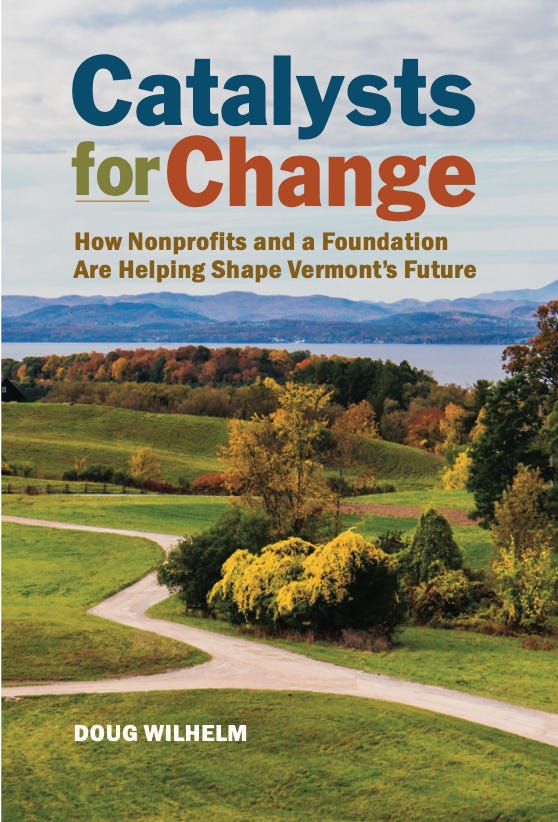
by Doug Wilhelm · Rootstock Publishing · $18.99
Read one way, this is an inspiring book. The people in these pages are real, the problems they tackled are serious, and the work documented across forty years is genuine. Readers who come to it at face value will find stories of Vermonters coming together to fight for clean water, sustainable energy, independent journalism, and healthy families. That experience is not wrong.
I came to it differently. I engaged with this book as a resource — a way to understand how systems are built, how power moves through institutions, and who sits at the center of the networks that shape Vermont’s policy landscape. Read that way, it is equally revealing.
Some books tell you more in the front matter than in the chapters. Catalysts for Change is one of them.
The book was commissioned by the Lintilhac Foundation of Shelburne, a private family foundation with $25.6 million in assets that has been operating in Vermont since 1975. It was introduced by the foundation’s executive director, Crea Lintilhac. It was written by Doug Wilhelm, a Weybridge writer who describes his professional work as helping organizations tell the stories they want to convey. And it was sourced almost entirely through interviews with organizations the foundation funds.
The acknowledgments thank those same organizations — VTDigger, Vermont Public, the Conservation Law Foundation, Vermont Natural Resources Council, VPIRG, the Trust for Public Land, and others — for their ability to “guide, advise, challenge and push us.” That closing line belongs to Crea Lintilhac herself.
Before you read a single chapter, the structure of the book has already told you something important.
Doug Wilhelm’s professional biography is relevant context here. By his own description, he has spent more than thirty years helping organizations tell the stories they want to convey, with nonprofits, foundations, and state and federal agencies among his clients. He is a skilled writer with a long Vermont career. He is also, by his own account, a professional whose work is to serve his clients’ narratives. Catalysts for Change is his eighteenth book. The Lintilhac Foundation is thanked by name for making it possible.
None of this is hidden. All of it matters.
The ten chapters of Catalysts for Change move through Vermont’s nonprofit landscape: nurse-midwifery, journalism, Lake Champlain, water quality, conservation, Vermont Yankee, clean energy, civic engagement. Each chapter draws its account primarily from interviews with the organizations featured — organizations that are, in most cases, Lintilhac grantees. Crea Lintilhac is interviewed across eight of the ten chapters. Among those interviewed is Trey Martin, executive director of the Vermont Housing and Conservation Board, whose role in Vermont’s conservation finance infrastructure has been documented elsewhere in this series. The foundation’s longtime single staff member, Nancy Brink, is credited in the acknowledgments as indispensable to the project.
The result is a book in which the foundation’s grantees tell the story of the foundation’s grantees, narrated by the foundation’s executive director, written by a professional hired to tell the story, published with the foundation’s support. Every source in the building is also a resident.
That’s not an accusation. It’s a description of a methodology. And the methodology is worth understanding.
The Lintilhac Foundation’s own published grant reports — available on its website — show that in 2023 the foundation granted $25,000 to the Vermont Journalism Trust, which operates VTDigger, and $40,000 directly to Vermont Public, specifically designated for Vermont Edition and Vermont This Week, the flagship public affairs programs most Vermonters rely on for statehouse coverage. Total 2023 grants across all recipients came to $1,137,885.
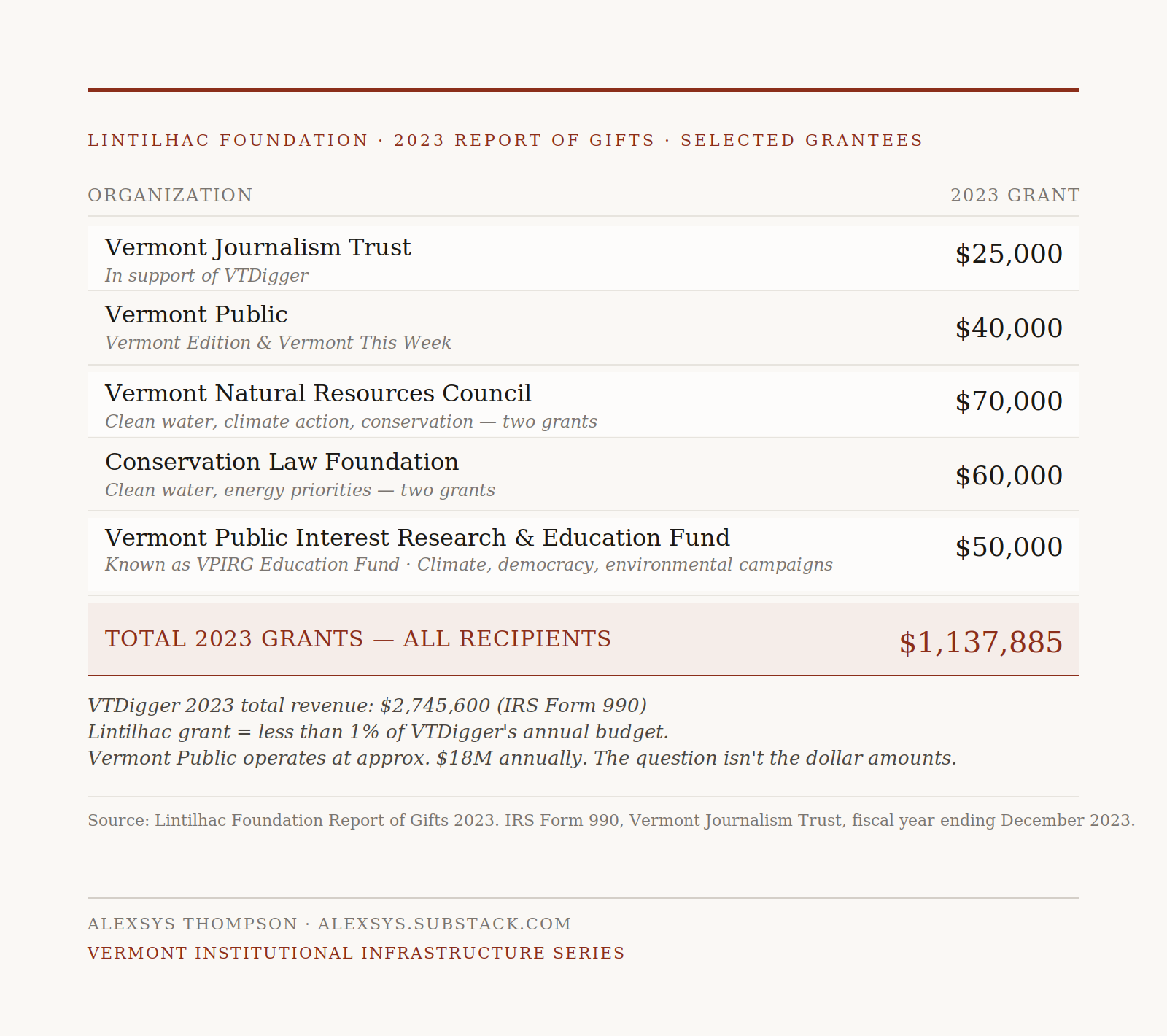
Source: Lintilhac Foundation Report of Gifts 2023, published by the foundation. VTDigger 2023 total revenue: $2,745,600 (IRS Form 990, fiscal year ending December 2023).
To put those media figures in context: VTDigger reported total revenue of $2.74 million in 2023, making the Lintilhac grant less than one percent of its budget. Vermont Public operates at a scale of roughly $18 million annually. By dollar volume alone, these grants don’t purchase editorial control. No serious person would argue they do.
But that’s not really the question.
The question is what the relationship buys that the dollars don’t. And the answer, at least in part, is this book. VTDigger’s founder appears as an interview source in Chapter 4. Vermont Public’s programming is described and celebrated in the acknowledgments. The foundation’s grantees are woven throughout every chapter as the authoritative voices on the challenges Vermont faces and the solutions that work. That kind of presence — being inside the narrative, being the source, being the story — is a different order of influence than a check.
In her introduction, Crea Lintilhac is direct about how the foundation operates. She describes a model that requires its trustees to join nonprofit boards of directors, attend legislative committee meetings at the State House, and be active members of the Vermont community. She calls this network of collaboration the mechanism by which the foundation and its grantees work together to shape outcomes.
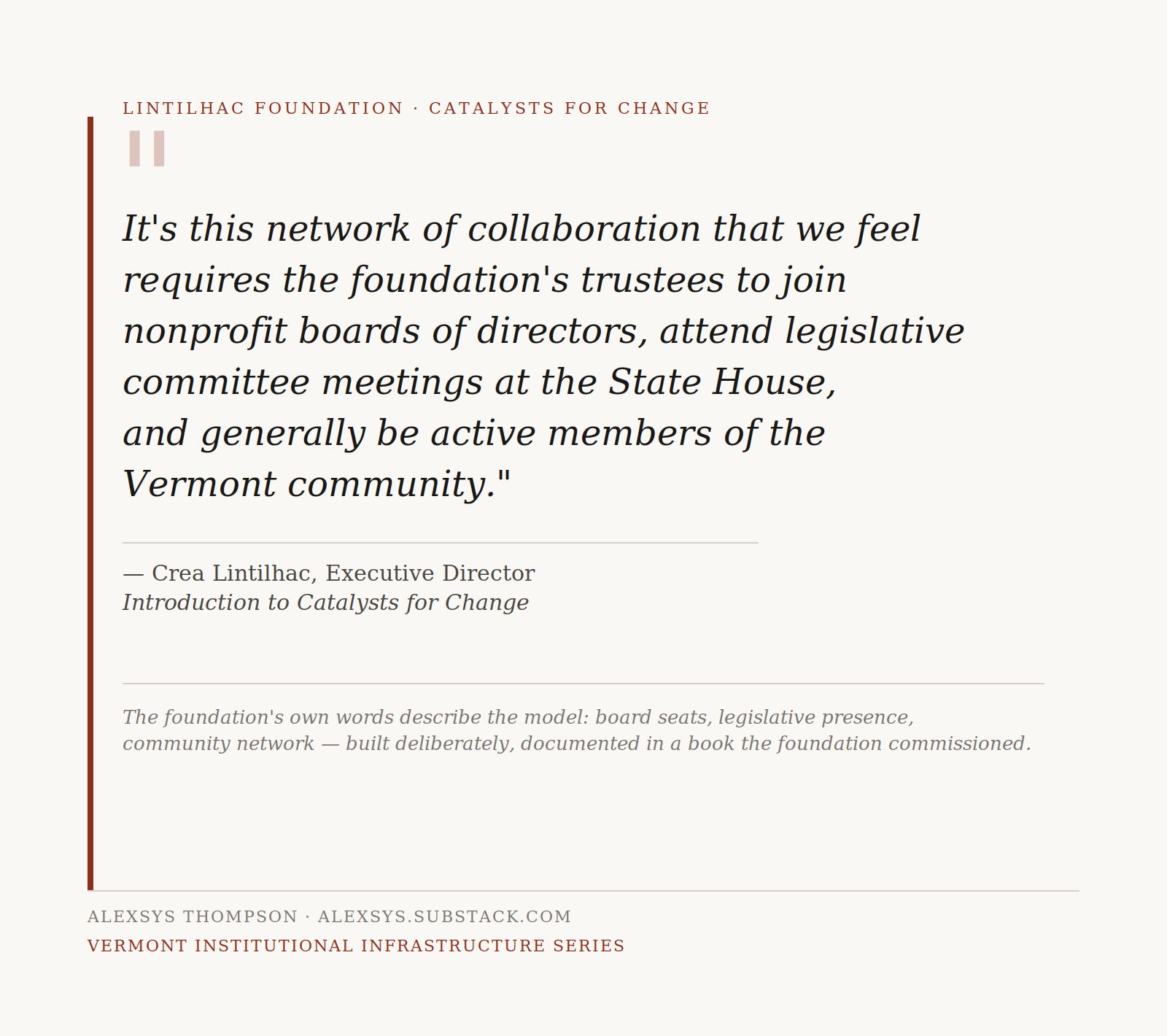
Read that slowly. A private family foundation whose trustees sit on the boards of the organizations that advocate for environmental and media policy, who attend the legislative committees where that policy is debated, who fund the journalism that covers those debates, and who commissioned a book in which all of those organizations tell their own story — that foundation has described its own model of influence with unusual candor.
No one in these pages did anything wrong. Vermont’s conservation and media infrastructure genuinely needs funding, and much of the work these organizations do is valuable to Vermonters. The foundation has been transparent about its grantmaking, publishing annual reports dating back more than a decade. The book exists. The sourcing is what it is.
But there is a difference between a network that forms organically around shared values and a network that is deliberately constructed, funded, and now documented in a foundation-commissioned book. Catalysts for Change is that documentation. It is a foundation describing, in its own words, how it built the spokes of a wheel — and inviting you to admire the craftsmanship without asking what’s at the center.
Vermonters who have been paying attention to how decisions get made in this state — who funds the groups that shape the policy, who sits in the rooms where the plans are drawn, whose story gets told and whose doesn’t — will find this book useful. Not for what it celebrates. For what it reveals.
Data tells stories. Patterns show convergence. Curiosity validates both.
If this series has been useful to you, consider subscribing or supporting it at https://ko-fi.com/alexsysthompson
And, Will Lintilhac is Chair of VNRC’s Board of Directors. And, Brendan Kinney made the seamless transition from COO of Vermont Public to CEO of VT Digger. Just sayin’.