
Digging Into Act 59, Part 1
The international partnership named in Vermont’s conservation law — and what the public record shows about how it got there

Correction 5/11/26: An earlier version of this piece stated that VCD Part 1 was overseen by Deputy Commissioner Sam Lincoln. Lincoln has clarified that he was asked to read the report and provide feedback during its development. The text has been updated to reflect that accurately
What the statute actually says — and what it doesn’t explain
When Vermont’s legislature passed Act 59 in June 2023 it made seventeen legislative findings before setting any goals or directing any agencies. Findings are the factual foundation of a law — the legislature’s stated reasons for acting. They are part of the statute itself.
Finding number eleven reads:
“The Staying Connected Initiative is an international partnership of public and private organizations. Its goal is to maintain, enhance, and restore landscape connectivity for wide-ranging mammals across the Northern Appalachians-Acadian region, from the Adirondack Mountains to the Maritime Provinces. The Staying Connected Initiative has identified nine linkages across this vast region that are extremely important to wildlife. Six of these linkages lie within Vermont.”
No further explanation. No disclosure of who runs it, who funds it, or who its Vermont members are. The legislature named it as a fact and moved on.
Most Vermonters have never heard of the Staying Connected Initiative. Most landowners whose properties carry Rural Conservation designations in Vermont’s Future Land Use Map — designations that survived S.325’s partial repeal in May 2026 and remain embedded in regional plans — have never heard of it either.
Here is what the public record shows.
The Staying Connected Initiative: who runs it, who funds it, who its Vermont members are
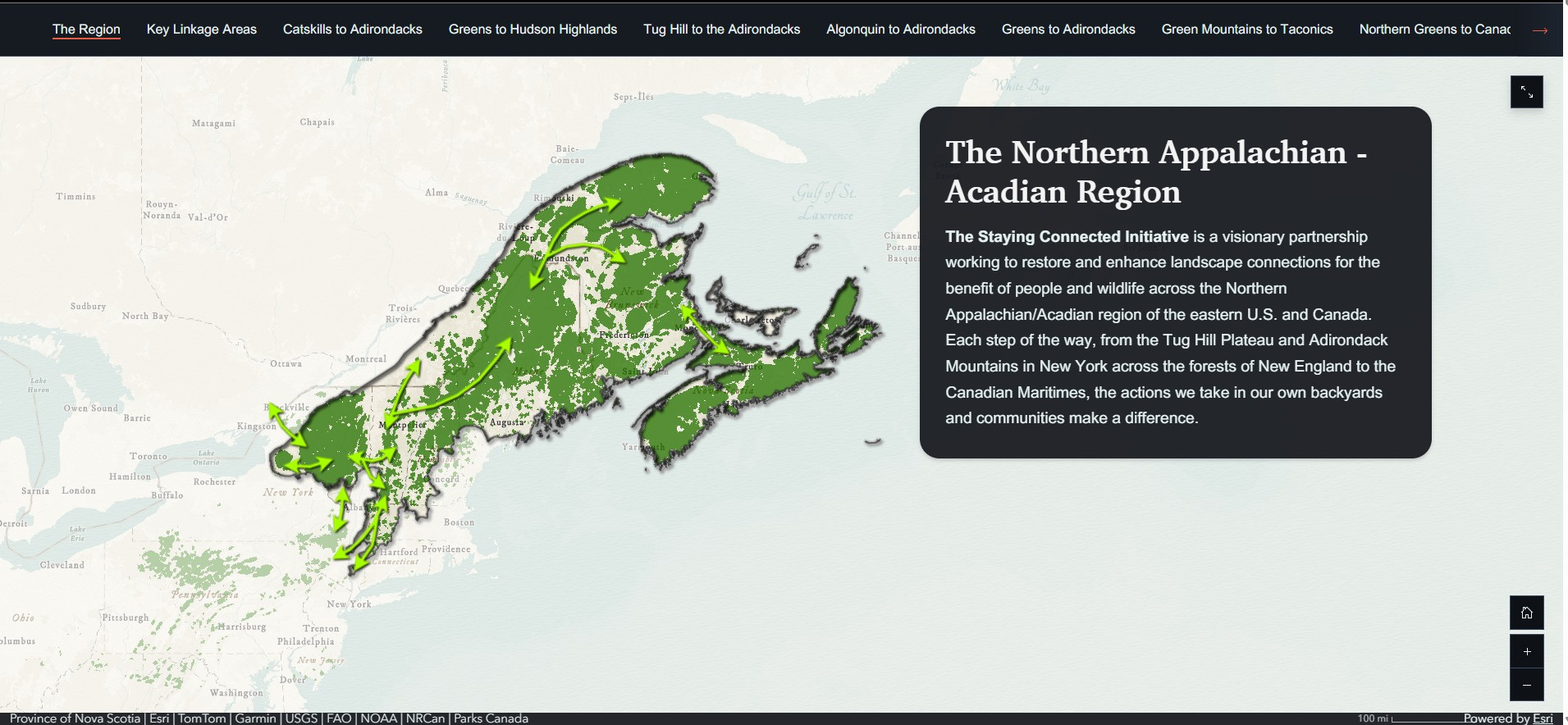
SCI full Northern Appalachian-Acadian region map. Caption: “The Northern Appalachian-Acadian region showing the nine wildlife linkage corridors identified by the Staying Connected Initiative. Six run through Vermont. Image source: Staying Connected Initiative — stayingconnectedinitiative.org”]
The Staying Connected Initiative is an international partnership of more than 80 organizations spanning six states and three Canadian provinces. It works to conserve and restore landscape connectivity across the Northern Appalachian-Acadian region — roughly 80 million acres of forest stretching from the Adirondacks to the Canadian Maritimes.
The Nature Conservancy is its primary fiscal sponsor and coordinator — documented by Highstead, a conservation organization, quoting TNC’s own regional coordinator Mikael Cejtin. Vermont members of SCI include TNC Vermont, Vermont Land Trust, Vermont Natural Resources Council, Vermont Department of Fish and Wildlife, Vermont Agency of Transportation, Northeast Wilderness Trust, and Wildlands Network, among others — documented on the Association of Vermont Conservation Commissions website.
SCI has identified nine wildlife linkage corridors across its region that it considers critical for landscape-scale connectivity. Six of those nine run through Vermont. Two run through northeastern Vermont and the Vermont-Quebec border region. The SCI interactive map tool identifies these as the Borderlands linkage and the Northern Greens to Canada linkage — corridors covering working farms, private forestland, and small towns across Vermont’s Northeast Kingdom.
To see where those corridors run through your county visit stayingconnectedinitiative.org and select Key Linkage Areas from the navigation.
SCI is not a government agency. It is not subject to public comment requirements or open meeting laws. It does not hold elected office. Its own website describes a core strategy of promoting and supporting government action on connectivity — including helping develop and promote best practices and policies that will sustain critical landscape connections across the region. A second core strategy describes supporting local action for conservation by providing technical assistance directly to municipalities and regional planning commissions — SCI’s own website states the partnership has helped secure meaningful improvements in the land use plans and policies of nearly 20 communities and 3 regional planning commissions.
TNC Vermont, Vermont Land Trust, and Vermont Natural Resources Council are among its Vermont members. All three organizations are registered lobbyists before the Vermont legislature — documented in the Vermont Secretary of State’s lobbyist registry. All three are named as partners or lead implementers in the Vermont Conservation Plan now being developed — documented in the VCP Draft Expanded Framework Report, January 2026.
That is not a conflict in the legal sense. It is a structure worth understanding.
Vermont Conservation Design: who built it, how it was funded, and what it was built for
Vermont Conservation Design is the science framework that Act 59 made into law. It appears three times in the statute — in the findings, in the goals, and in the planning mandate. It is the spine of Act 59 and the foundation of the designations that followed.
VCD was not created by the legislature. It was built in two phases by state employees at Vermont Fish and Wildlife and the Department of Forests, Parks and Recreation, working with conservation organization partners.
Part 1 — the Landscapes technical report — was published in December 2015. The primary author was Eric Sorenson of Vermont Fish and Wildlife. Commissioner Louis Porter and Deputy Commissioner Sam Lincoln of FPR provided feedback on the report during its development. It was funded by the U.S. Fish and Wildlife Service through State Wildlife Grants — documented in the VCD Summary Report acknowledgments, February 2018.
Part 2 — Natural Communities and Habitats — was published in March 2018. Keith Thompson of FPR led the Young Forest and Old Forest workgroup. Bob Zaino of Vermont Fish and Wildlife led the Aquatic Habitats workgroup. TNC’s Dan Farrell and Rose Paul contributed to multiple workgroups. Also funded by U.S. Fish and Wildlife State Wildlife Grants — documented in the VCD Part 2 technical report contributor list.
The people who built Vermont Conservation Design were state scientists and wildlife biologists doing their jobs with federal funding. The science they produced is serious work built over years of careful analysis. That is not in dispute.
What is worth understanding is what happened next.
Vermont Conservation Design was never subject to a public comment process. It was never voted on by the legislature. It was a science and planning tool — useful for informing conservation decisions, land trust priorities, and town planning — until Act 59 made it the statutory guide for planning the conservation of half of Vermont’s land. At that point it carried a different weight. A science product developed for planning purposes became the statutory guide for regulatory decisions affecting private landowners — without a subsequent public comment process specific to that regulatory use.
TNC Vermont contributed staff to VCD’s development — documented in the VCD Part 2 technical report. TNC Vermont is a registered lobbyist before the Vermont legislature — documented in the Vermont Secretary of State’s lobbyist registry. Lauren Oates, TNC Vermont’s Director of External Affairs, testified at the H.70 hearing in February 2026 — documented in the Vermont Legislature’s public record. Vermont Land Trust is named as a partner in VCD’s development — documented in the University of Vermont’s summary of VCD published by the Rubenstein School. Vermont Land Trust is a registered lobbyist before the Vermont legislature — documented in the Vermont Secretary of State’s lobbyist registry.
To see Vermont Conservation Design’s Highest Priority Connectivity Blocks mapped across your county visit Vermont Agency of Natural Resources BioFinder at biofinder.vt.gov — select the Landscape Scale layer under Vermont Conservation Design.
The chain from science product to your regional plan
Here is the chain, documented from primary sources.
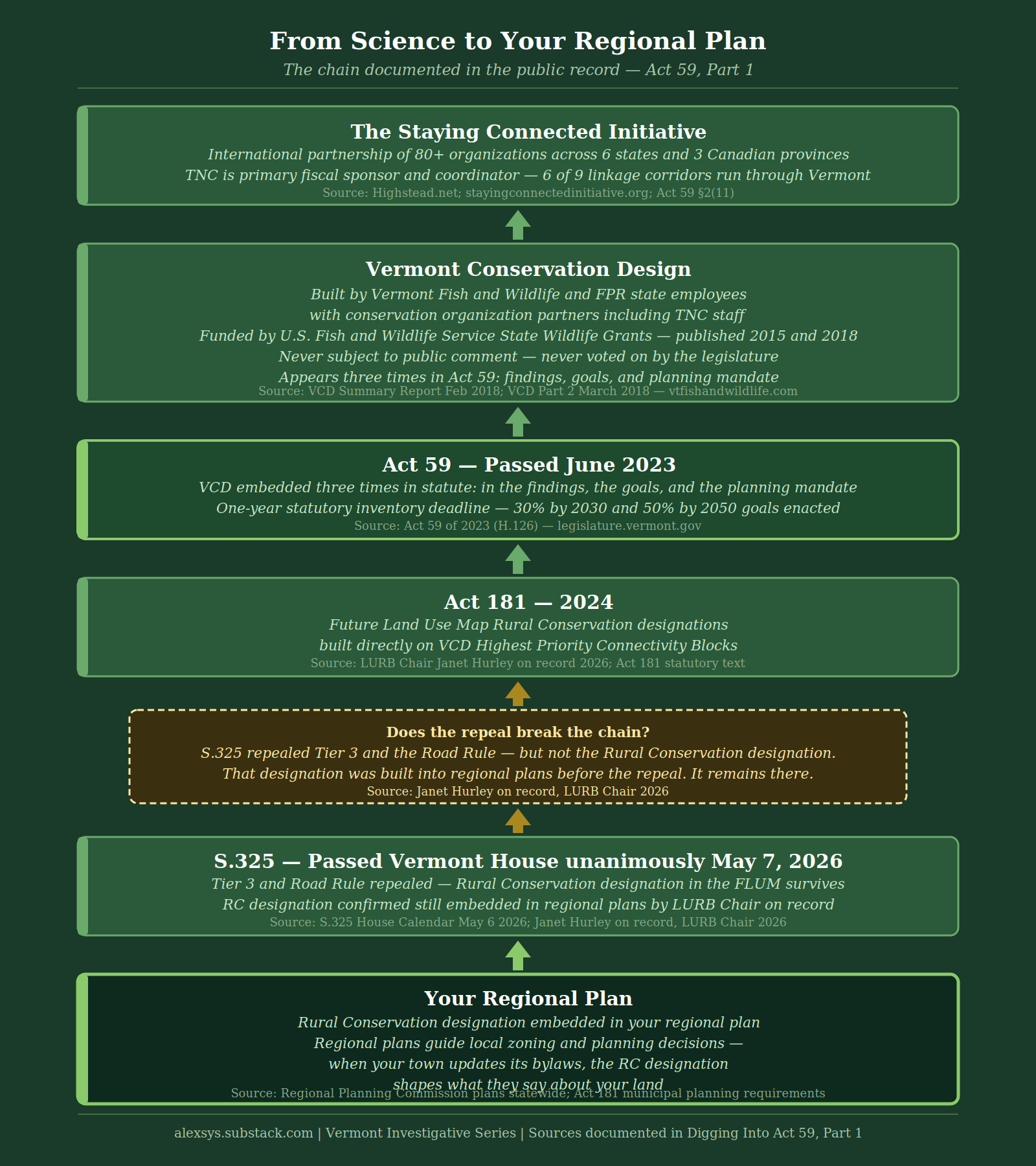
The Staying Connected Initiative identified wildlife linkage corridors across the Northern Appalachians. TNC developed the Resilient and Connected Landscapes project mapping those corridors. Vermont Fish and Wildlife, working with TNC and other conservation organizations, built Vermont Conservation Design using those corridors as a foundation. Act 59 embedded VCD in statute as the guide for Vermont’s 30x30 and 50x50 conservation goals. Act 181 built its Future Land Use Map Rural Conservation designations directly on VCD’s Highest Priority Connectivity Blocks.
S.325, which passed the Vermont House unanimously on May 7, 2026, repealed Tier 3 and the Road Rule. It did not repeal the Rural Conservation designation in the FLUM. LURB Chair Janet Hurley confirmed on the record that the RC designation survives the repeal and remains embedded in regional plans. Act 250 Criterion 10 conformance — which requires that development projects conform to regional plan designations — still applies.
What that means in plain English: the regulatory teeth were pulled. The underlying framework remains.
That designation reflects a chain of science and policy decisions documented in the public record — from SCI’s linkage mapping to Vermont Conservation Design to Act 59’s statutory goals to Act 181’s FLUM. This piece makes that chain visible so readers can examine it.
Who was in the rooms — and who had to fight to get there
The working groups that produced Vermont’s conservation planning foundation met for approximately six months beginning in January 2024. They met every other week, two hours at a time. Participants were given less than 24 hours to review final draft reports before they were due. The Act 59 Phase I Inventory Report documents that the initial oversight group included VHCB, ANR, TNC, and Vermont Land Trust. Additional statewide partners including Audubon Vermont and Trust for Public Land were invited to provide initial input and help identify stakeholders. No dissenting opinions appear in the published Phase I report despite participants being offered that option — confirmed by VHCB project manager Trey Martin on the record.
These are the same working groups that Jennifer Byrne had to fight her way into.
Byrne is the Manager of the White River Natural Resources Conservation District — a subdivision of Vermont state government, federally designated as part of the infrastructure for locally led conservation planning. Her district employs certified conservation planners, a certified forester, an agronomist, and grazing and agroforestry specialists. Conservation Districts are governed by elected supervisors.
Conservation Districts were not named in Act 59’s statutory stakeholder list — confirmed by VHCB project manager Trey Martin on the record: “They were not listed as the stakeholders we were supposed to engage with — they were omitted. I don’t know why this happened. We weren’t the drafters of the statute.” Byrne raised the omission herself and was incorporated mid-process.
In the Agriculture Working Group’s final recorded meeting on March 29, 2024 — a meeting posted publicly on VHCB’s website — after months of trying to have Conservation Districts formally named in the group’s recommendations, Byrne said: “I give up. If I’m not allowed to speak then I’m done trying.”
The meeting closed with VHCB’s Agricultural Director acknowledging what everyone in the room already knew: “I think we all will definitely agree there was not enough time for this.”
Trey Martin confirmed the time pressure extended across all five working groups: “All five working groups really felt like we could have spent a lot more time on this.” The statutory one-year deadline made anything else impossible — confirmed by Martin on the record.
In April 2024 Byrne delivered written testimony to the Vermont House Agriculture Committee — a public document in the Vermont Legislature’s record. She described the contractor hired to run the process as “an organization that specializes in facilitating access to carbon markets globally.” She described being told repeatedly that the process “was never meant to be a public process, does not have to abide by open meeting laws, and that VHCB has the final say of what is recommended to ANR.” She questioned the entire expenditure publicly and urged the committee to “reconsider the direction of or completely repeal the 30x30 Conservation Strategy Initiative.”
The committee heard her testimony. It is in the Vermont Legislature’s public record.
Full Piece on this here
The questions the public record hasn’t answered — and why they matter before June
This piece does not argue that wildlife connectivity is unimportant. It does not argue that Vermont’s landscape doesn’t need protection. The science behind VCD is real. The ecological concerns that motivated SCI are real. The loss of forest connectivity is a documented trend. The organizations involved in this work have genuine conservation records.
What the public record raises are structural questions that deserve answers before Vermont’s Conservation Plan is finalized this summer.
The statute names the Staying Connected Initiative as a legislative finding. Legislative findings routinely cite external science and organizations without disclosing their funding relationships. Whether the legislature was aware that TNC — which lobbied for the bill — is also SCI's primary fiscal sponsor and coordinator is not documented in the public record reviewed for this piece.
When Vermont Conservation Design was embedded in statute as the guide for planning the conservation of half of Vermont’s land, was there any discussion about subjecting it to a public comment process first?
The organizations whose staff contributed to building VCD are the same organizations that lobbied for Act 59 and Act 181. They are named as lead implementers in the Vermont Conservation Plan now being developed. They hold land in Current Use receiving public tax reductions — documented in the Vermont Department of Taxes Current Use data reviewed for Part XI of this series. Some administer carbon market programs available to landowners whose properties fall within the connectivity corridors VCD identified — documented in FFCP program materials and the VCP Draft Expanded Framework Report.
None of that is illegal. All of it is structural. And all of it is worth understanding before Vermont’s Conservation Plan is finalized this summer — because that plan will determine what the Rural Conservation designation means for your property, your town plan, and your regional plan going forward.
The Vermont Conservation Plan is due to the legislature by June 2026. Public input opportunities remain open. Your regional planning commission will be asked to incorporate its recommendations. Your selectboard will be asked to update town plans accordingly.
You now know where the framework came from. The questions are yours to ask.
Support this work at ko-fi.com/alexsysthompson
Primary Sources
Act 59 of 2023 (H.126) — legislature.vermont.gov
Vermont Conservation Design Summary Report, February 2018 — vtfishandwildlife.com
Vermont Conservation Design Part 2: Natural Communities and Habitats, March 2018
Vermont Conservation Design development summary — University of Vermont Rubenstein School, uvm.edu
Staying Connected Initiative member list and interactive map — stayingconnectedinitiative.org
Staying Connected Initiative — Policy Development — stayingconnectedinitiative.org/what-we-do/policy-development
Staying Connected Initiative — Land Use Planning — stayingconnectedinitiative.org/what-we-do/land-use-planning
TNC as SCI primary fiscal sponsor — Highstead.net, September 2024
Vermont Conservation Plan Draft Expanded Framework Report, January 2026 — vhcb.org
Act 59 Phase I Inventory Report, 2024 — vhcb.org
Jennifer Byrne written testimony, House Agriculture Committee, April 10, 2024 — Vermont Legislature public record
Agriculture Working Group final meeting recording, March 29, 2024 — vhcb.org
S.325 House Calendar, May 6, 2026 — legislature.vermont.gov
Vermont Secretary of State lobbyist registry — sos.vermont.gov
Janet Hurley on-record confirmation, LURB Chair, 2026
Trey Martin on-record confirmation, VHCB project manager, 2026
Lauren Oates H.70 testimony — Vermont Legislature public record, February 2026
Vermont Department of Taxes Current Use data — Part XI of this series, alexsys.substack.com