

Part XV: Published at alexsys.substack.com
Vermont’s House of Representatives is on the floor with S.325 this week — legislation repealing key provisions of Act 181, the land use law built on Act 59’s conservation framework. Rep. Amy Sheldon, who chairs the House Environment and Energy Committee, is leading that work. The public record shows she also worked with the National Caucus of Environmental Legislators to draft Act 59 — including the one-year inventory deadline at the center of this piece. As lawmakers debate the fallout from that framework, a review of how Vermont’s conservation planning process compared to the nine other states with 30x30 goals raises a question the public record has not previously addressed: why did Vermont do this differently than everyone else and at what cost?
Section 1 — The Money
Vermont set out to plan the conservation of 30 percent of its landscape by 2030 and 50 percent by 2050. To do it, the state turned to outside contractors. Neither firm is Vermont-based. Neither registered as a lobbyist. The public record does not document when or how the contractors’ backgrounds were disclosed to working group participants.
The funding behind this work is a matter of public record. The Vermont legislature appropriated $75,000 to the Vermont Housing and Conservation Board for outreach, and $150,000 to the Agency of Natural Resources for staff time. The National Fish and Wildlife Foundation — a federal quasi-governmental entity chartered by Congress in 1984 — provided a $1 million grant to VHCB through the America the Beautiful Challenge, a competitive federal conservation grant program that funded projects across 46 states in 2023. Trey Martin, VHCB’s Vermont Conservation Plan project manager, confirmed the funding structure, and said the NFWF grant was on pace to be fully spent by June 30, 2026.
For Phase I, VHCB contracted with Zoraya Hightower, a Vermont-based independent consultant, who used Nature for Justice as her billing and project management platform. Nature for Justice is a Virginia-based organization founded in 2020. Martin confirmed the arrangement: “She was not hired because of her connection to Nature for Justice, but for her leadership and expertise on connected Vermont issues like Environmental Justice.” N4J CEO Hank Cauley confirmed that N4J served as “the contracting and fiscal sponsor entity” for Hightower’s consultant team. VHCB’s contract with Nature for Justice, signed August 2023, carried an original cap of $225,000. An amendment authorized an additional $25,101.12 for stipends and third-party outreach costs. The total paid to Nature for Justice was $250,101.12, confirmed by VHCB General Counsel Elizabeth Egan on May 6, 2026.
Nature for Justice’s stated mission at its founding was facilitating access to global carbon markets. Cauley acknowledged that N4J’s early public-facing materials “placed greater emphasis on equitable access to carbon markets,” and said the mission language has since evolved. The organization’s current mission statement describes connecting communities to “global nature markets” alongside grant funding and technical resources.
For Phase II, VHCB selected Future iQ as the principal contractor for communications and project management. Future iQ is based in Minnesota. Their published project portfolio — spanning work from 2004 through the present — includes regional planning, economic development, tourism development, defense sector engagement, and agricultural scenario planning. It contains no prior biodiversity planning, conservation work, or 30x30 engagement before Vermont. Future iQ CEO David Beurle, in response to a right-of-reply inquiry, said the firm’s work also includes “comprehensive master planning” with “a strong focus on stakeholder engagement and input, across a range of topics.” He did not identify prior conservation or biodiversity work.
Martin described Future iQ’s role plainly: “They would be really helping us behind the scenes — not the subject matter experts or the content developers.”
Section 2 — What Vermont Did That No Other State Did
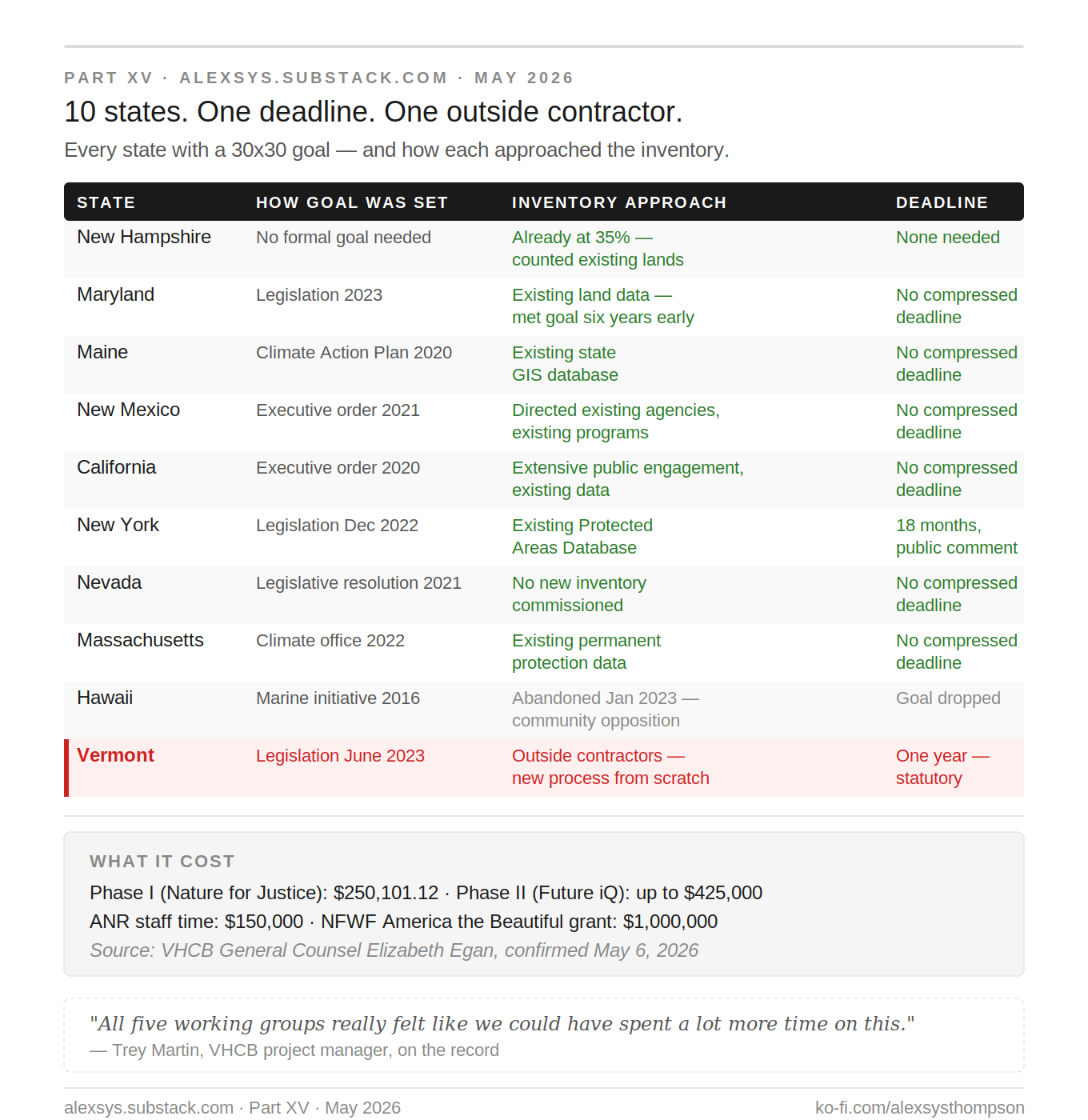
Ten states have established 30x30 conservation goals. Vermont is one of them. It is the only one that set a one-year statutory inventory deadline and hired outside contractors to run a new statewide engagement process from scratch.
The National Caucus of Environmental Legislators — the same organization that helped draft Vermont’s Act 59 — maintains a tracker of all ten states’ approaches. The picture it documents is consistent across every state except Vermont.
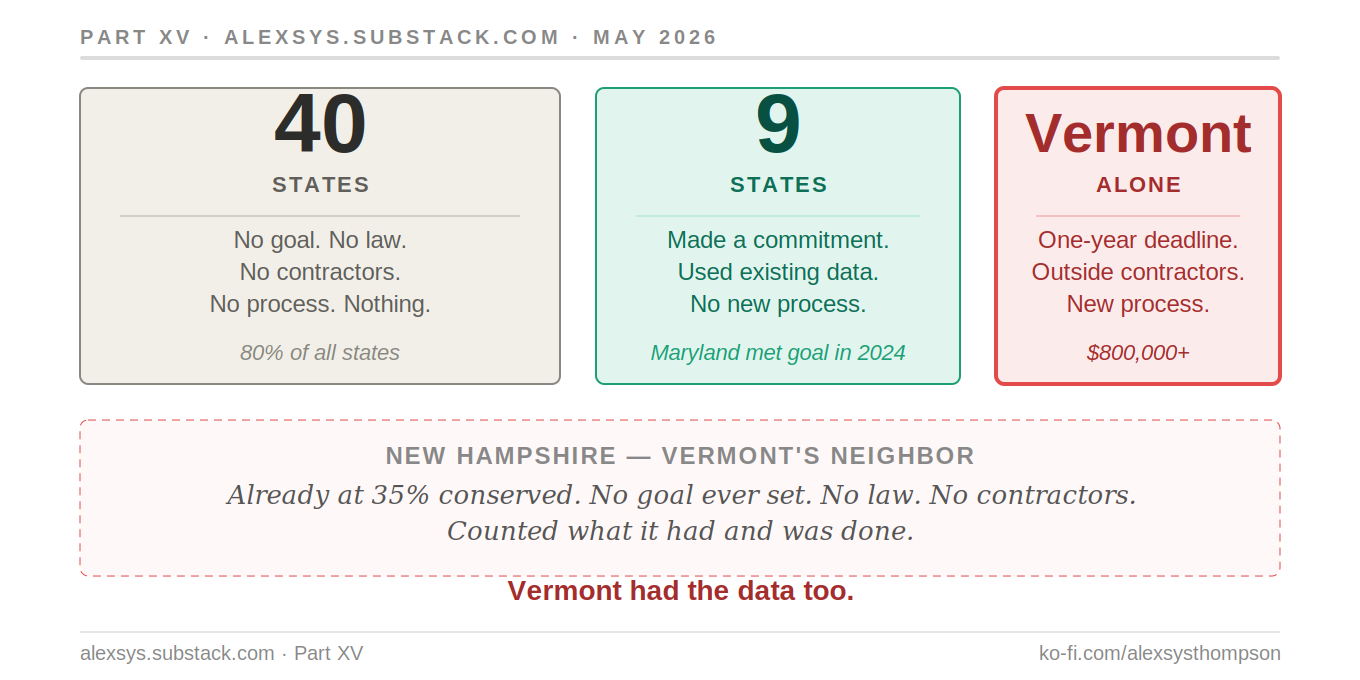
New Hampshire never needed a plan at all. Roughly 35 percent of its land is already conserved, largely through the White Mountain National Forest. New Hampshire counted what it had and was done.
Maine set its 30x30 goal in December 2020 through its Climate Action Plan. It used its existing state Conserved Lands Database — a GIS layer already maintained by the state’s Natural Areas Program — as the baseline. No new inventory process. No outside contractors. No compressed deadline. Maine is currently at 22 percent conserved. Maine’s approach to carbon accounting was equally direct: it assigned a statewide carbon stocks inventory to the state DEP and the University of Maine, drawing on existing USDA Forest Service data already collected annually. No new engagement infrastructure. Scientists running existing data through existing methodologies.
Maryland passed 30x30 legislation in 2023 — the same year as Vermont’s Act 59 — and met its goal in May 2024, six years ahead of schedule, making it the first state to reach 30x30. It used existing land protection data tracked through the Maryland Protected Lands Dashboard, built on six decades of existing conservation programs. No new process commissioned. Maryland is now moving toward a 40x40 goal using the same infrastructure.
New York passed its 30x30 law in December 2022. It used the existing New York Protected Areas Database as its baseline, then released draft strategies for public comment in July 2024 — 18 months after passage — before adopting a final plan. No hard statutory inventory deadline.
New Mexico set its goal through a 2021 executive order directing existing state agencies to use existing programs, funding, and authorities. No new process commissioned. No outside contractors. No compressed deadline. As of 2023, New Mexico was still completing its baseline analysis of what counts as conserved — four years after setting the goal.
California set its goal through a 2020 executive order. It undertook extensive public engagement to define what “conserved” means before setting targets. No compressed one-year deadline. California’s 2024 progress report noted that a portion of its remaining gap would be closed simply by finding already-conserved land not yet recorded in statewide databases — land that existed but hadn’t been counted.
Nevada passed the first state 30x30 resolution in the nation in 2021. No formal inventory process. No percentage reported.
Massachusetts set its goal in 2022 using existing permanent protection data. No compressed deadline. Currently at approximately 27 percent.
New Jersey announced in June 2025 that it had already met the 30x30 goal — before formally setting it. Its Green Acres program, created in 1961, had quietly done the work over 64 years.
Hawaii set a marine 30x30 goal in 2016, then quietly abandoned it in January 2023 after community opposition to the pace and design of the process.
Vermont set a one-year statutory deadline — July 1, 2024, one year after Act 59 passed — to inventory 5.9 million acres and conduct stakeholder engagement across the state. That timeline required outside contractors, compressed working group meetings, and a process built around existing conservation organizations because the timeline permitted nothing else.
The data Vermont needed already existed in state systems. The Phase I inventory report drew on existing records held by VHCB, ANR, Vermont Land Trust, The Nature Conservancy, and state tax databases. The 27 percent figure — approximately 1.58 million acres permanently conserved through conservation easements or public ownership — comes from VHCB’s own Phase I inventory report. That data existed in state systems before Act 59 passed.
Vermont set a goal and went looking for the data. Maryland had the data and met the goal the same year Vermont passed the law. New Hampshire had the data and never needed a goal at all.
Who set that timeline is a matter of public record. According to NCEL’s own website, Rep. Amy Sheldon, who chaired the House Environment and Energy Committee when Act 59 passed, had been working with NCEL staff since 2020 to develop the bill. NCEL provided draft bill language, talking points, and example management plans. The one-year deadline was in the bill NCEL helped draft. Rep. Sheldon did not respond to requests for comment.
Section 3 — What Jennifer Byrne Said Out Loud
On April 10, 2024, Jennifer Byrne stood before the Vermont House Agriculture Committee and delivered written testimony that went significantly further than anything the working group had produced.
Byrne is the Manager of the White River Natural Resources Conservation District, a subdivision of state government covering watersheds across four Vermont counties. Her district employs certified conservation planners, grazing specialists, agroforestry specialists, a certified forester, and an agronomist. She had been sitting in Act 59’s Agriculture Working Group meetings since January — every other week, two hours at a time. Conservation Districts were not named in Act 59’s stakeholder list. Byrne and other district representatives raised that omission themselves and were incorporated into the process after doing so.
Her testimony addressed the process, the contractor, and the underlying goals of the initiative.
On the contractor: “The contractor hired to facilitate the overall public engagement process, though staffed with good hearted people, are an organization that specializes in facilitating access to carbon markets globally.” She did not name the contractor. The contractor’s name does not appear in the committee record. That contractor’s billing platform was Nature for Justice, the organization whose CEO acknowledged in response to a right-of-reply inquiry that their early public-facing materials "placed greater emphasis on equitable access to carbon markets."
On the process itself: “We on the agriculture working group were reminded repeatedly that this was never meant to be a public process, does not have to abide by open meeting laws, and that VHCB has the final say of what is recommended to ANR.” She noted directly that if the process had instead sat with the Natural Resources Conservation Council and the Conservation Districts, it would have inherently been a public process.
On the working group timeline: “The initiative’s implementation has seemed hurried, with deadlines prioritized over meaningful dialogue and consensus-building.” Most of the participating organizations did not formally approve the final report because they were given less than 24 hours for final review.
On the role of large conservation organizations: Her testimony stated that large conservation organizations were playing a disproportionately influential role in the initiative, and that the initiative risked commodifying Vermont’s natural landscape for private financial interests rather than the public good.
On findings that were ignored: The Soil Health and Payment for Ecosystem Services Working Group had met for over three years examining conservation incentives before Act 59’s process began. Its final report explicitly documented concerns about what it called the “financialization of nature” — warning that “natural asset companies” had emerged as a new class of publicly traded assets “designed to create a new market whose assets generate trillions of dollars in ecosystem services annually.” Byrne testified that requests to begin the Act 59 Agriculture Working Group’s conversation where the PES working group left off “were ignored or shelved for the next phase of the process.”
On carbon market verifiers: She stated that the world’s largest carbon market verifiers, including firms promoted and used by TNC in Vermont, had been “exposed as frauds in the pages of Time, the Guardian, Bloomberg, and many other reputable publications” since the PES working group concluded its work.
On the Environmental Justice Act: Vermont passed its first EJ Act two years prior to Byrne’s testimony, setting deadlines for state agencies to come into compliance with Title VI of the Civil Rights Act and establishing the policy that no person in Vermont bear an unequal share of environmental burdens. Byrne testified that as a member of Vermont’s Environmental Justice Advisory Council, she could say that not a single deadline in the act had been met. “Where is the urgency and emphasis to meet those deadlines? If similar emphasis was put on meaningful involvement of impacted community members in environmental decision making, we would likely not even have Act 59 in its current form.”
On the budget: She questioned the entire expenditure publicly, asking the committee to “dig deeper into the budget for this initiative relative to the public good it will serve.” She described firsthand accounts of “catered lunches and day long meetings of the core oversight team, circling the drain on the same questions for hours on end,” with meeting minutes not posted publicly.
Her conclusion was not a call for reform. “I urge you to reconsider the direction of or completely repeal the 30x30 Conservation Strategy Initiative.”
Byrne’s testimony is a public document, submitted to the Vermont Legislature on April 10, 2024, and available in the Vermont Legislature’s public record. The committee heard it.
VHCB’s own Phase I Inventory Report confirms the consultant team’s role in leading stakeholder engagement from July 2023 through September 2024 — conducting approximately 50 stakeholder interviews and facilitating more than 25 focus groups across Vermont. Martin confirmed that the time pressure was real: “All five working groups really felt like we could have spent a lot more time on this.”
Section 4 — Inside the Last Meeting
On March 29, 2024, the Agriculture Working Group of the Act 59 Conservation Strategy Initiative held its final meeting. It was recorded and posted publicly on the VHCB website, where it remains available today.
The meeting opened with Ryan Patch, a Vermont Agency of Agriculture, Food and Markets Agriculture Climate and Land Use Policy Manager who had been tasked with producing the working group’s final document, describing what the preceding months had felt like. “Really, it feels like an argument,” he said. “I really wish it wasn’t.” The Vermont Agency of Agriculture, Food and Markets said it had no concerns about the comments attributed to Patch. Patch was on leave at the time of publication and unavailable for comment.
The group had been given less than 24 hours to review the draft report before it was due. Caroline Gordon of Rural Vermont, who had participated throughout the process, gave the draft a thumbs down. The report, she said, did not reflect the working group’s actual discourse — particularly its opposition to carbon markets as a conservation tool. “Even though our discourse was to oppose carbon markets, that’s not being reflected,” she said. “Instead, it’s literally proposing the opposite.”

Patch’s response was direct: there would be no reference to carbon markets in the document. A straw poll had found most working group members were agnostic. The report’s narrow focus — establishing that conserved agricultural land should count toward Act 59 goals — was the priority.
Jennifer Byrne had a different concern. She had been trying, across multiple meetings, to have Conservation Districts formally named in the working group’s recommendations. In the final meeting, she tried again. The discussion that followed was long and circular. Other participants said they thought districts were implicitly included. Byrne pushed back. “We’re specifically not listed in this law,” she said. “We are specifically not listed.”
She was talked over. The conversation moved on.
Near the end of the meeting Byrne said: “I give up. If I’m not allowed to speak then I’m done trying.”
The meeting closed with Stacy Cibula, VHCB’s Agricultural Director, who co-chaired the working group alongside Patch, acknowledging what everyone in the room already knew: “I think we all will definitely agree there was not enough time for this.”
Martin confirmed that the time pressure extended beyond the Agriculture Working Group: “All five working groups really felt like we could have spent a lot more time on this.” He said VHCB pushed groups to closure knowing “many people wanted to come back and continue to talk about these questions in the Phase Two process,” and that VHCB was under a statutory obligation to deliver the Phase I inventory before moving forward.
Participants were offered the option of submitting dissenting opinions as an appendix. No appendix appears in the published Phase I report. Martin confirmed this: “There were people throughout the Phase I process who expressed criticism or frustration of the process. We tried very hard to include and elevate those voices and points in the inventory report.” The Phase I report does document deep disagreement on the agricultural lands question, quoting critical comments from stakeholders and legislators verbatim. The Phase I report does not address process concerns about the contractor’s background or the working group timeline.
Section 5 — The Funding Chain and Contractor Selection
The money and contractor selection process behind Vermont’s conservation planning are now documented through both public records and on-record confirmation from VHCB.

The confirmed funding structure: $75,000 from the Vermont legislature to VHCB for outreach. $150,000 to ANR for staff time. A $1 million grant from the National Fish and Wildlife Foundation through the America the Beautiful Challenge to VHCB for Phase II. These figures were presented at a public Conservation District listening session on March 19, 2026, and confirmed in writing by VHCB General Counsel Elizabeth Egan on May 6, 2026.
For Phase I, VHCB hired Zoraya Hightower, a Vermont-based independent consultant with a background in environmental policy and community engagement, who had previously served as a Burlington City Councilor. Hightower used Nature for Justice as her billing and project management infrastructure. Her team included approximately five consultants total. VHCB’s total payment to Nature for Justice, including pass-through costs, was $250,101.12, covering work from August 2023 through July 2024.
For Phase II, VHCB issued a competitive RFP on October 1, 2024, posting it publicly on VHCB’s website and Vermont’s state procurement portal. Seven proposals were ultimately received. Three firms were interviewed: Metamorphic Consulting, the Wagenvoord Group, and Future iQ. VHCB’s board approved the Future iQ contract on January 24, 2025 by resolution.
The RFP listed conservation expertise as a “strong plus” for candidates — not a requirement. The mandatory qualifications were project management experience, facilitation capacity, budget management, and demonstrated ability to produce written work product. Of the seven proposals received, Future iQ scored highest on VHCB’s evaluation rubric, earning 14 out of 15 points. VHCB’s own procurement documentation describes Future iQ as having “relevant experience in Vermont, including the Vermont Forest Strategic Roadmap” and “strong logistical and planning capabilities, with a clear and cohesive vision for stakeholder engagement and deliverables.” It does not reference prior conservation planning, biodiversity, or 30x30 experience.
Future iQ came to VHCB’s attention through two prior relationships. VHCB’s Liz Gleason, Director of the Farm and Forest Viability Program, had been a stakeholder in the Forest Future Roadmap process. Danielle Fitzko, Commissioner of Vermont’s Department of Forests, Parks and Recreation at the Agency of Natural Resources, had led that contract and recommended Future iQ highly. Martin explained the rationale: “Their work on the Vermont Forest Future Strategic Roadmap was a really important factor in the decision to hire them for this process, because they had been in Vermont, they had worked with a lot of the stakeholders who we knew would be part of the Act 59 process, and they understood a lot of the issues and cultural tensions that exist here whenever we sit down and start talking about land use.”
Martin described a second rationale for selecting an outside facilitator: neutrality. A firm without pre-existing allegiances to Vermont’s conservation community could run a process without an organizational stake in the outcome. “Another strong aspect of Future iQ’s proposal,” Martin said, “was their demonstrated ability to bring public planning conversations and projects effectively to conclusion, while supporting broad outreach and communication.”
The Wagenvoord Group — the firm of Helen Wagenvoord of Shelburne, Vermont — scored 11 out of 15 on VHCB’s rubric. VHCB’s own evaluation described the group as having “deep understanding of Vermont’s conservation history and strong qualifications, but limited evidence of delivering large-scale, comprehensive plans.” The Wagenvoord Group was subsequently engaged by VHCB in a separate consulting capacity to support internal planning processes.
Future iQ’s contract with VHCB commenced May 2025, with an original cap of $305,000. A February 2026 amendment authorized up to $120,000 in additional partner costs for stakeholder listening sessions, bringing the total contract value to $425,000. Martin said: “Our process was not intended as a gateway for investors outside the state to be involved in ownership of Vermont’s Rural Lands.” On carbon markets specifically, Martin noted that VHCB does not administer carbon market programs, and that voluntary payments to landowners should be ethical, equitable, and effective.
Section 6 — What the Law Required
Act 59 was specific about who should be at the table.
The statute named the stakeholders VHCB was required to include: private owners of forestlands and agricultural lands, land trusts, conservation organizations, environmental organizations, working lands enterprises, outdoor recreation groups, Indigenous groups, watershed groups, municipalities, regional planning commissions, conservation commissions, and relevant state and federal agencies.
Natural Resources Conservation Districts are not on that list.
This is not a minor omission. Conservation Districts are a subdivision of Vermont state government, created under the 1939 Soil Conservation Act and operating under federal guidance that explicitly designates them as the infrastructure for locally-led conservation planning. Section 500 of the USDA Programs Manual defines their role: locally-led conservation begins with the community itself, working through the local conservation district. Vermont has fourteen Conservation Districts. They are democratically governed by elected supervisors.
Martin confirmed the omission: “They were not listed as the stakeholders we were supposed to engage with — they were omitted. I don’t know why this happened. We weren’t the drafters of the statute.” He said VHCB believes it was simply an oversight. Once Conservation Districts raised the issue themselves, VHCB incorporated them: Claire Ireland from the Association of Conservation Districts joined the inter-agency planning team for Phase I, and Jennifer Byrne and Michael Fernandez from different districts participated in working groups.
In Phase II, VHCB provided grants totaling $32,000 to eight Conservation Districts for stakeholder-led listening sessions — giving districts the funding to facilitate their own feedback sessions rather than having VHCB direct the process. Byrne confirmed the structure: VHCB offered $4,000 grants to organizations willing to facilitate local engagement conversations on Act 59, with approximately 30 organizations participating, some of which were Conservation Districts.
One of those funded sessions was the White River NRCD Board of Supervisors meeting on March 19, 2026 — a gathering attended by supervisors from three Vermont Conservation Districts. Their meeting minutes, submitted as a public document to VHCB on April 1, 2026, described the current conservation plan as “overly centralized, lacking clear implementation pathways, and insufficiently incorporating grassroots input, conservation districts, and existing partnerships.”
Also present at that Conservation District meeting: Earl Hatley, President of the Ottauquechee Water Protectors Association, an Indigenous representative of Abenaki, Shawnee, and Cherokee heritage. Indigenous voices were present in the Conservation Districts’ own planning process. The Phase I report identifies Indigenous representation as a gap that was not fully addressed in Phase I.
Vermont also had another relevant body of work available before Act 59’s planning process began. The Soil Health and Payment for Ecosystem Services Working Group had met for over three years examining conservation incentives and funding mechanisms for agricultural land. Its final report explicitly warned about what it called the “financialization of nature.” Those findings were not incorporated into the Act 59 planning process. Working group participants who raised these concerns during the Agriculture Working Group meetings were told the topic was not appropriate for the current phase.
Section 7 — The public record also reflects what Vermont has built.
Alex Weinhagen, who joined the Land Use Review Board a year ago expecting to focus on refining Act 250, has watched Act 181’s implementation consume his agency’s bandwidth. He is cautiously optimistic now that the Road Rule and Tier 3 repeal have cleared the House Environment Committee. But when asked about Vermont’s conservation record, he doesn’t hesitate.
Vermont has already conserved 27 percent of its landscape — close enough to the 30 percent goal, in his view, to acknowledge what has been accomplished. "I think we should just call that a victory and move on," he said in a May 1, 2026 phone call, the substance of which he confirmed in writing. He noted that if Current Use forest land enrollment is counted the way it currently stands, Vermont is likely already very close to the 50 by 50 goal. In his individual view — he was not speaking for the Land Use Review Board — Vermonters should be proud of what has already been accomplished on conservation.
The 27 percent figure comes from VHCB’s own Phase I inventory report. Approximately 1.58 million acres of Vermont land are permanently conserved through conservation easements or public ownership. That data existed in state systems before Act 59 passed.
Jamey Fidel, Vice President of Audubon Vermont and a registered lobbyist, testified at the H.70 hearing in February 2026 that Vermont is already at the 50 by 50 goal if Current Use is counted. His concern was what acknowledging it might mean for the planning process. Counting Current Use and declaring success, he said, risks “deflating the planning effort” — the years of work still needed to understand how Vermont’s landscape will hold together as climate pressures increase and landowners face new economic realities.
The Phase II planning process began in September 2024 — three months after the Phase I inventory showing Vermont near its goals was published. Future iQ is the principal contractor. The plan is due to the legislature by June 2026.
Whether the planning process Vermont built was the right one for the moment — whether a different timeline, a different contractor selection, a different stakeholder framework would have produced something more durable — is not a question this piece can answer. What the public record shows is what was chosen, who was hired, what it cost, and what some of the people inside the process said about it while the recording was running.
What this piece does and does not do.
This piece documents the public record of how Vermont’s Act 59 conservation planning process was designed, who ran it, what it cost, and what people inside it said about it. It draws on VHCB procurement documents produced in response to a public records request, on-record interviews with VHCB project staff, publicly posted working group recordings, written testimony submitted to the Vermont Legislature, and a review of how the nine other states with 30x30 goals approached the same task.
This piece does not argue that conservation is wrong, that Vermont’s landscape does not need protection, or that the people who designed this process acted in bad faith. The Phase I inventory report is a serious document. The organizations involved have genuine conservation records. The goal of understanding and protecting Vermont’s landscape is not in dispute here.
What is in dispute is the process — and the assumption behind it.
Vermont passed Act 59 in June 2023, becoming the first government in the world to enshrine a 50x50 conservation goal in statute. At the time, 27 percent of Vermont’s land was already permanently conserved — data that existed in state systems before the law passed. New Hampshire, Vermont’s neighbor, is already at 35 percent conserved. New Hampshire never set a goal. New Hampshire never hired outside contractors. New Hampshire never built a new process. New Hampshire counted what it had and was done.
Vermont counted what it had too — and spent over $800,000 and two years of compressed working group meetings doing it.
The question this piece asks is not whether Vermont should conserve land. It is whether the process Vermont built to document what it already had was the right one — and why Vermont built it differently than every other state that made the same commitment.
Support this work at ko-fi.com/alexsysthompson
Primary sources
Vermont Legislature
Act 59 of 2023 (H.126) — legislature.vermont.gov
Jennifer Byrne written testimony, House Agriculture Committee, April 10, 2024 — Vermont Legislature public record
Vermont Housing and Conservation Board
Act 59 Phase I Inventory Report, 2024 — vhcb.org
Phase II procurement documents (RFP, scoring rubric, board resolution, contracts) — produced in response to public records request, May 2026
Nature for Justice contract and amendments — confirmed by VHCB General Counsel Elizabeth Egan, May 6, 2026
Future iQ contract and amendments — confirmed by VHCB General Counsel Elizabeth Egan, May 6, 2026
Agriculture Working Group final meeting recording, March 29, 2024 — posted publicly on VHCB website
National Caucus of Environmental Legislators
30x30 Midpoint: Are States on Track? (updated January 23, 2026) — ncelenviro.org
State primary sources
Maine Won’t Wait: Four-Year Plan for Climate Action, December 2020 — maine.gov
New York State 30x30 Draft Strategies and Methodology, July 2024 — dec.ny.gov
New Mexico Executive Order 2021-052 — governor.state.nm.us
Maryland the Beautiful Act Five-Year Plan, 2024 — planning.maryland.gov
California 30x30 Annual Progress Report, September 2024 — resources.ca.gov
New Jersey Governor’s Office announcement, June 3, 2025 — nj.gov
Federal
Executive Order 14008, Tackling the Climate Crisis at Home and Abroad, January 27, 2021
Kunming-Montreal Global Biodiversity Framework, December 2022
USDA Programs Manual, Section 500, Subpart A: Locally Led Conservation Defined — directives.sc.egov.usda.gov
Vermont public record
White River NRCD Board of Supervisors meeting minutes, March 19, 2026 — submitted to VHCB April 1, 2026
Soil Health and Payment for Ecosystem Services Working Group final report — Vermont Agency of Agriculture, Food and Markets
Support this work at ko-fi.com/alexsysthompson
Once again, stellar writing, research, information and explanation. THANK YOU