
Good Intentions Don’t Make Law
This isn't a Chess Game. These Are People's Lives

Update — May 14, 2026
Rep. Michael Boutin (R-Barre City), speaking on the floor during the May 12 debate, offered what may have been the sharpest statement of the day:
“Respect the committee process. Easy to say when you control the entire process. A process where you can kill any bill with ease. Imagine if the tables were turned. Would the same folks respect the process?”
Rep. Michael Tagliavia (R), a member of the House Environment Committee, posted publicly on his official Facebook page following the vote:
“Most of the members who joined us to approve the Burtt amendments last week were reprimanded so badly by party leadership that they didn’t dare to vote with us again in support of rural Vermonters this week.”
Tagliavia was referring to the Burtt amendments added to S.325 the week before the H.70 vote — which added homesteading, small-scale agriculture, and forestry to the definition of smart growth and exempted accessory on-farm businesses from Act 250 review. Both amendments passed with bipartisan support before the H.70 vote.
His public statement suggests the 80-58 vote on H.70 was shaped not only by process arguments but by political consequences for members who had already crossed party lines the previous week.
The Vermont Investigative series will continue to report on the S.325 Conference Committee and the Act 59 planning process as they develop.
SOURCES: Vermont Daily Chronicle, May 13, 2026. Rep. Michael Tagliavia, official Facebook page, May 14, 2026.
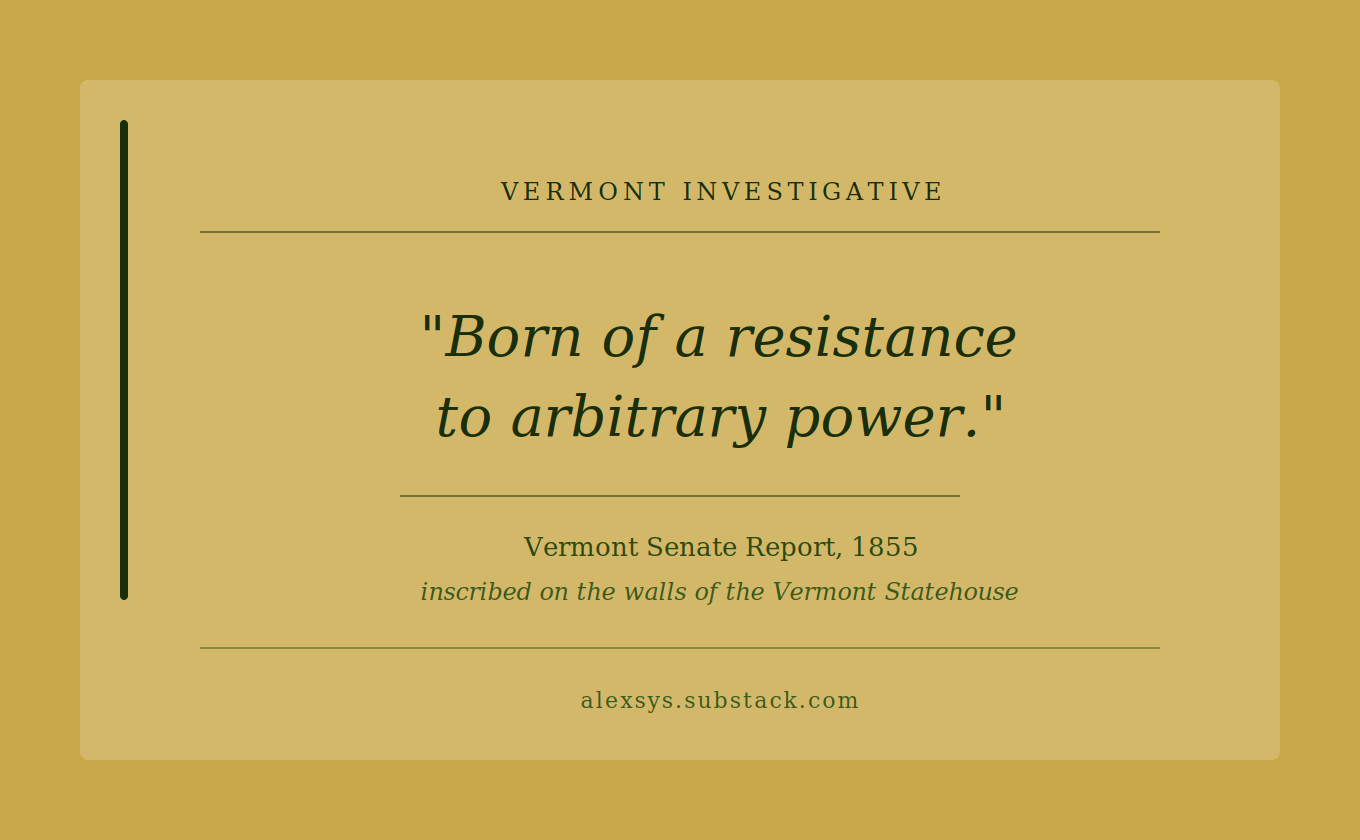
On May 12, 2026, the Vermont House of Representatives voted 80 to 58 to keep House Bill 70 on the wall of the Environment Committee — where it has waited since January 2025.
The vote was the second time this session the House declined to move the bill. The first, on February 5, failed 86 to 48. Between those two votes, the yes coalition grew by ten.
The session ends May 17. H.70 dies on the wall. The coalition is still growing.
This is not a story about a bill that failed. It is a story about what the record shows — in committee transcripts, in official statements, in roll call votes, and in the gap between what was said on the floor and what actually happened in the room.
The data tells a story. The pattern shows convergence. Here is what the record shows.
What H.70 Actually Was
House Bill 70 is a simple bill. It proposes adding agricultural land and forestland enrolled in Vermont’s Use Value Appraisal program — commonly known as current use — to the definition of conserved land under Act 59, Vermont’s conservation goals legislation.
Act 59 commits Vermont to conserving 30% of its land by 2030 and 50% by 2050. Vermont is the only state in the country with both a 30x30 and a 50x50 goal — the most ambitious conservation commitment of any state — and the implications of that commitment for working landowners have been hiding in plain sight.
The UVA program currently enrolls approximately 2.5 million acres of working farms and forests. These lands are managed under professional forest management plans, subject to regulatory oversight, and have kept Vermont’s landscape intact and productive across generations. Under the current definition of conserved land in Act 59, they do not count toward either goal.
H.70 proposed to count them toward the path from 30% to 50% by 2050 — as exactly what they are — a long-term land protection mechanism already doing conservation work.
One clarification the record requires: H.70 would not have restricted a single acre of UVA enrolled land. It would not have added new requirements, new easements, or new oversight. The Use Value Appraisal program is voluntary. Landowners choose to enroll. They can leave for a fee. Their land remains theirs to manage, sell, develop, or pass on.
H.70 did not ask landowners to give anything up. It asked the state to acknowledge what they have already given.
The bill was introduced on January 23, 2025. It was assigned to the House Environment Committee. It received one day of testimony — February 27, 2026 — fourteen months after introduction. It was never voted on in committee.
On February 5, 2026, a motion to bring it to the floor failed 48 to 86. On May 12, 2026, a second motion failed 58 to 80. Between those two votes, ten members changed their position to yes.
VERIFIED: Roll call records, Vermont Legislature, H.70, 2025-2026 session.
What the Transcripts Show
On May 12, Rep. Lori Houghton of Essex Junction offered this account on the House floor:
“On March 11 at 10:05AM, the committee of jurisdiction took testimony on H.70, hearing from witnesses with various viewpoints with committee discussion after and with an offer from the chair to take a vote. No vote was moved.”
Read plainly, that account places the failure on the bill’s supporters. They had their chance. Nobody took it.
The public record tells a different story — on two counts.
First: No testimony was taken on March 11
The March 11 session was not a testimony session. Chair Sheldon opened it with these words:
“This is a committee discussion largely, to decide if we are going to want to continue taking testimony on this bill and or do we need to vote on it?”
No witnesses. No testimony. An internal committee discussion in which members stated their positions around the table — four for H.70, seven against, including the chair.
At the close, the chair said this:
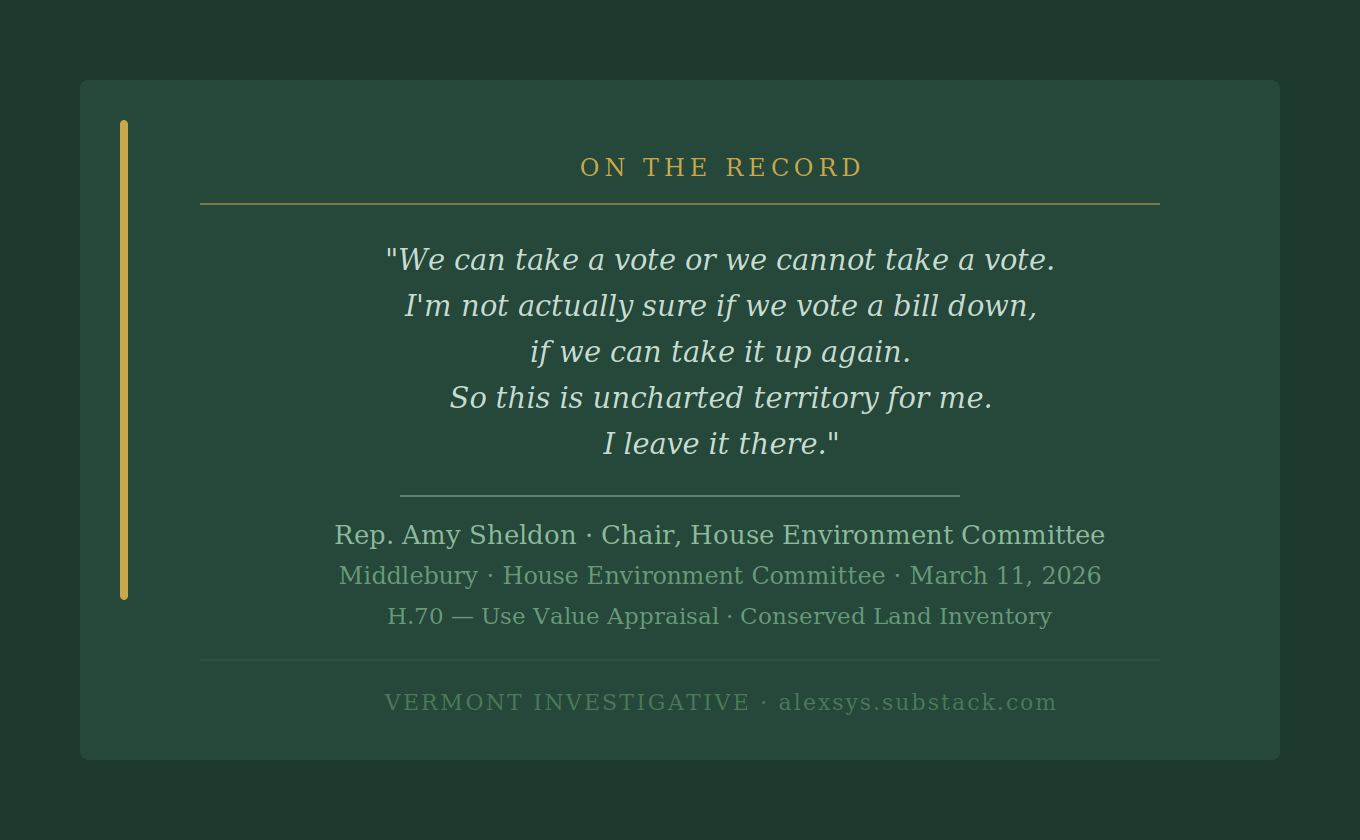
“We can take a vote or we cannot take a vote. I’m not actually sure if we vote a bill down, if we can take it up again. So this is uncharted territory for me. I leave it there.”
She then moved on to the next agenda item. No vote was called.
Second: The bill’s supporters didn’t decline a vote. They moved for one.
Six weeks earlier — on February 27, the one day the committee did hear testimony on H.70 — a committee member moved for an immediate vote at the close of testimony. The motion was seconded. The chair called a recess. No vote was taken.
The bill’s supporters did not decline a vote. They moved for one. It didn’t happen.
Any committee member could have moved for a vote on March 11. None did. The chair’s uncertainty about the consequences of a committee loss — expressed in a room where seven members opposed the bill and four supported it — left the motion unmoved by either side. That is a different thing than supporters declining an offer.
Rep. Houghton’s floor statement describes a testimony session that did not occur and a vote offer that the transcripts do not support.
The transcripts are public record.
VERIFIED: Golden Dome SmartTranscripts, House Environment Committee, February 27, 2026 and March 11, 2026. Floor transcript, Vermont House of Representatives, May 12, 2026.
What Convergence Looks Like
The record on H.70 tells a story in sequence. Four moments. The same message building across three months.
February 27, 2026 — The testimony session
The committee heard six witnesses — the first and only full testimony session on H.70 in fourteen months. At the close of testimony a committee member moved for an immediate vote. The motion was seconded. The chair called a recess. No vote was taken.
March 11, 2026 — The committee discussion
The committee convened for an internal discussion — no witnesses, no testimony. Members stated their positions around the table. Four supported H.70. Seven — including the chair — opposed it or recommended waiting for the Act 59 planning process to conclude. The chair raised the question of a vote, expressed uncertainty about what a committee loss would mean procedurally, and moved on without calling one.
May 12, 2026 — The morning of the vote
Rep. Theresa Wood of Waterbury published an opinion piece in the Waterbury Roundabout opposing the Rule 51 motion on the morning of the floor vote. Her framing: process is sacred. Invoking Rule 51 was “leap-frogging committee process.” The piece included a statement from the Vermont Housing and Conservation Board confirming UVA would count toward the 50x50 goal through the Act 59 planning process.
May 12, 2026 — The floor
Rep. Lori Houghton of Essex Junction stated on the floor that the committee had taken testimony on March 11, that the chair had offered a vote, and that no one had moved for one.
The transcripts show no testimony was taken on March 11. The transcripts show the chair raised the question of a vote, expressed uncertainty about consequences, and moved on without calling one. The transcripts show a motion to vote on February 27 was made, seconded, and responded to with a recess.
Four moments. The same message: process is sacred, the committee is handling it, there is no need to bypass the system.
The Vermont Investigative series does not draw conclusions about intent. What the record shows is a pattern — a bill that had majority opposition in committee, that was never brought to a vote despite two opportunities, whose supporters were told on the floor that the committee had heard testimony and been offered a vote that no one took, and whose opponents published the process argument publicly the morning of the floor vote.
Patterns show convergence. This one does.
VERIFIED: Waterbury Roundabout, Rep. Theresa Wood opinion, May 12, 2026. Golden Dome SmartTranscripts, House Environment Committee, February 27 and March 11, 2026. Floor transcript, Vermont House of Representatives, May 12, 2026.
Good Intentions Don’t Make Law
On May 11, 2026 — the day before the House floor vote on H.70 — Rep. Theresa Wood of Waterbury published a statement that included a formal response from the Vermont Housing and Conservation Board.
The VHCB statement confirmed the following, on the record:
That UVA meets the definition of long-term land protection mechanisms under Act 59. That UVA enrolled lands will be counted as durably protected toward the 50x50 goal. That permanently conserved lands also enrolled in UVA already count toward the 30x30 goal. That the Act 59 conservation plan will be nonbinding and subject to review by the General Assembly.
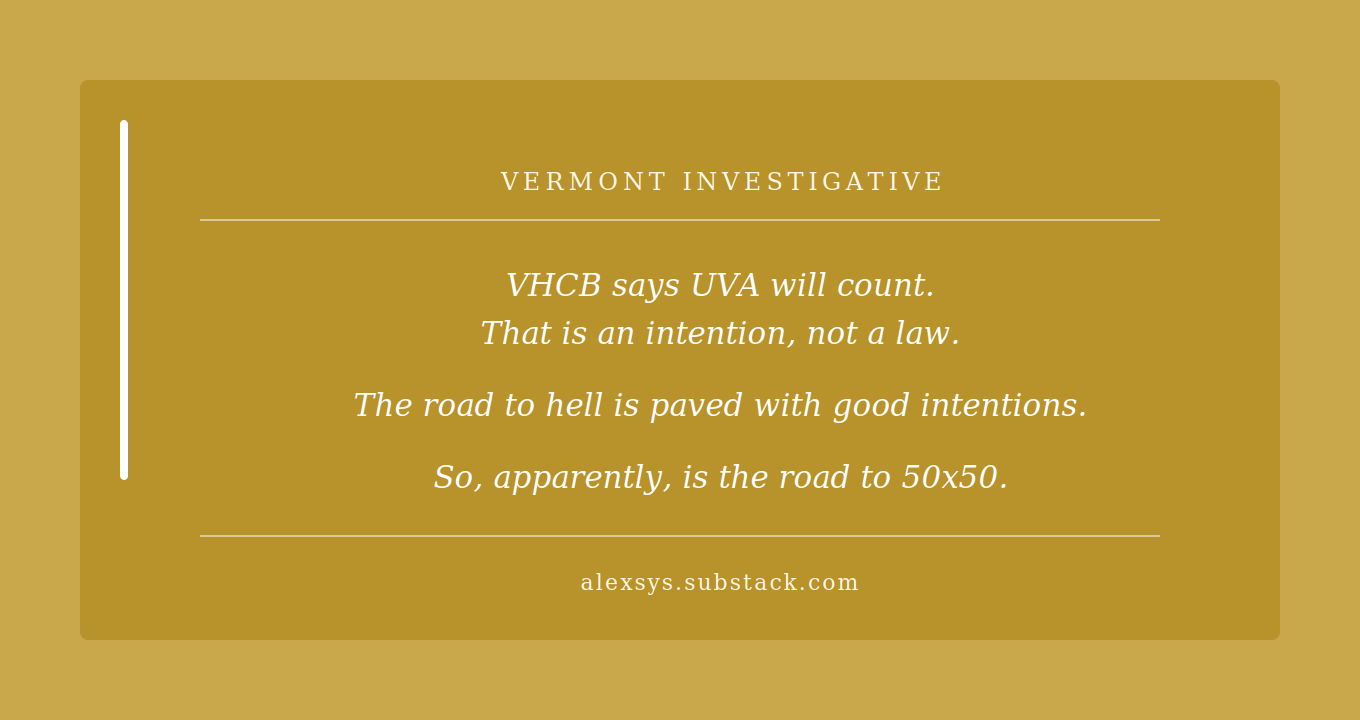
If VHCB intends to count UVA toward the 50x50 goal anyway, passing H.70 would have cost nothing — and built the trust that eighteen months of process has failed to build.
That is not what happened.
Because there is a difference between a planning process and a statute. Between an agency’s intention and a legal protection. Between a nonbinding plan subject to future legislative review and a bill signed into law.
Act 181 was full of good intentions. It passed with two-thirds majorities. It was vetoed and overridden. Two years later the House voted unanimously to gut it — because the intentions embedded in the planning process did not translate into outcomes that served the people the law was supposed to protect.
They are not wrong to want H.70 in statute rather than in a planning document.
VERIFIED: VHCB statement as published in Waterbury Roundabout, May 11, 2026. Act 59, 10 VSA Chapter 20. Vermont House roll call, S.325, May 2026.
What Vermont Is Choosing Not to Count
Vermont’s official conserved land inventory stands at approximately 27% — 1,576,783 acres permanently protected through conservation easements or public ownership. That number is the basis for Vermont’s progress toward its 30x30 goal. It does not count the 2.5 million acres enrolled in the Use Value Appraisal program.
H.70 was specifically addressing the path from 30% to 50% by 2050 — where Act 59 explicitly allows for durable long-term land protection mechanisms rather than requiring permanent conservation. UVA meets that definition. VHCB has confirmed it on the record.
If UVA land is included toward the 50x50 goal — as H.70 proposed, as VHCB says it will recommend in its nonbinding plan — Vermont is not behind. When permanently protected land and UVA enrolled land are combined, Vermont is at approximately 61% — already past both the 30x30 and 50x50 thresholds.
One clarification the record requires: counting UVA land toward conservation goals would not restrict a single acre. The program is voluntary. Landowners can leave. Their land remains theirs. H.70 asked the state to count what landowners are already doing — nothing more.
Vermont is not behind on its conservation goals. Vermont is choosing not to count the people who are meeting them.
The risk of leaving it to the plan
The Act 59 conservation plan is nonbinding. It is subject to review by the General Assembly — the same body that just voted 80 to 58 to keep H.70 on the wall. Legislative priorities shift. Administrations change. A nonbinding plan recommended by one VHCB board can be revised, delayed, or deprioritized by the next.
H.70 would have put UVA’s role in the 50x50 goal into statute. Not into a plan. Not into a recommendation. Into law — where it would have survived a change in administration, a shift in legislative priorities, or a future VHCB board with different interpretations of “durable.”
The biennium ends May 17. H.70 dies on the wall. If the coalition wants statutory protection for UVA’s role in the 50x50 goal, they start over next session — in January 2027 — with a new bill, a new committee assignment, and an 18-month clock reset to zero.
Meanwhile the Act 59 plan moves forward on its own timeline — nonbinding, subject to review, carrying the good intentions of an agency that has confirmed what the landowners have been saying all along. Good intentions don’t make law.
And in Vermont, where Act 181 just demonstrated what happens when good intentions meet an unorganized constituency, the working landowners who have been showing up — at the Statehouse, in the inboxes, at the rally, in the balcony — are not wrong to want more than a promise. They want a statute. They didn’t get one. Yet.
This is not only a Vermont story
Across the ten states that have adopted formal 30x30 or 50x50 conservation goals, the same tension is playing out — between permanently protected land and the working farms and forests that keep landscapes intact without a conservation easement attached. Maine counts working lands. Vermont doesn’t — yet. The definitions vary. The politics vary. The pattern does not.
And underneath all of it, the federal funding that once made ambitious conservation goals financially achievable is no longer reliable. The Biden-era conservation programs that were flowing to Vermont for land acquisition have been reduced or eliminated. A nonbinding state plan that depended on federal dollars to become real is now a nonbinding state plan without the dollars. (For the full federal funding picture, see: Digging Into Act 59, Part 5.)
Vermont’s working landowners are not just navigating a state planning process. They are navigating a state planning process in a moment when the federal infrastructure that supported it is being dismantled — and when the only protection that doesn’t depend on either is a statute that just failed 80 to 58.
VERIFIED: VHCB Phase I Inventory, 2024. Vermont Department of Taxes, Use Value Appraisal annual report, 2025. Act 59, 10 VSA Chapter 20. VHCB statement as published in Waterbury Roundabout, May 11, 2026.
What to Watch
The Vermont legislative session ends May 17, 2026. H.70 dies on the wall of the House Environment Committee for the second time in this biennium. The coalition that brought it to the floor is not done.
Between February 5 and May 12, ten members changed their position to yes. The vote moved from 48-86 to 58-80 without a single additional committee hearing, without a public campaign, and without the bill ever reaching the floor through normal process. It got there through Rule 51 — a mechanism invoked fewer than five times in forty years.
That coalition now has the following on the record: A VHCB statement confirming UVA meets the definition of durable long-term land protection under Act 59. A committee transcript showing a motion to vote was made, seconded, and responded to with a recess on February 27. A committee transcript showing the chair expressed uncertainty about the consequences of a committee loss on March 11 — in a room where the math was 7-4 against. A floor statement from Rep. Houghton that is not supported by either transcript. A growing yes coalition that spans Republicans, Democrats, and independents.
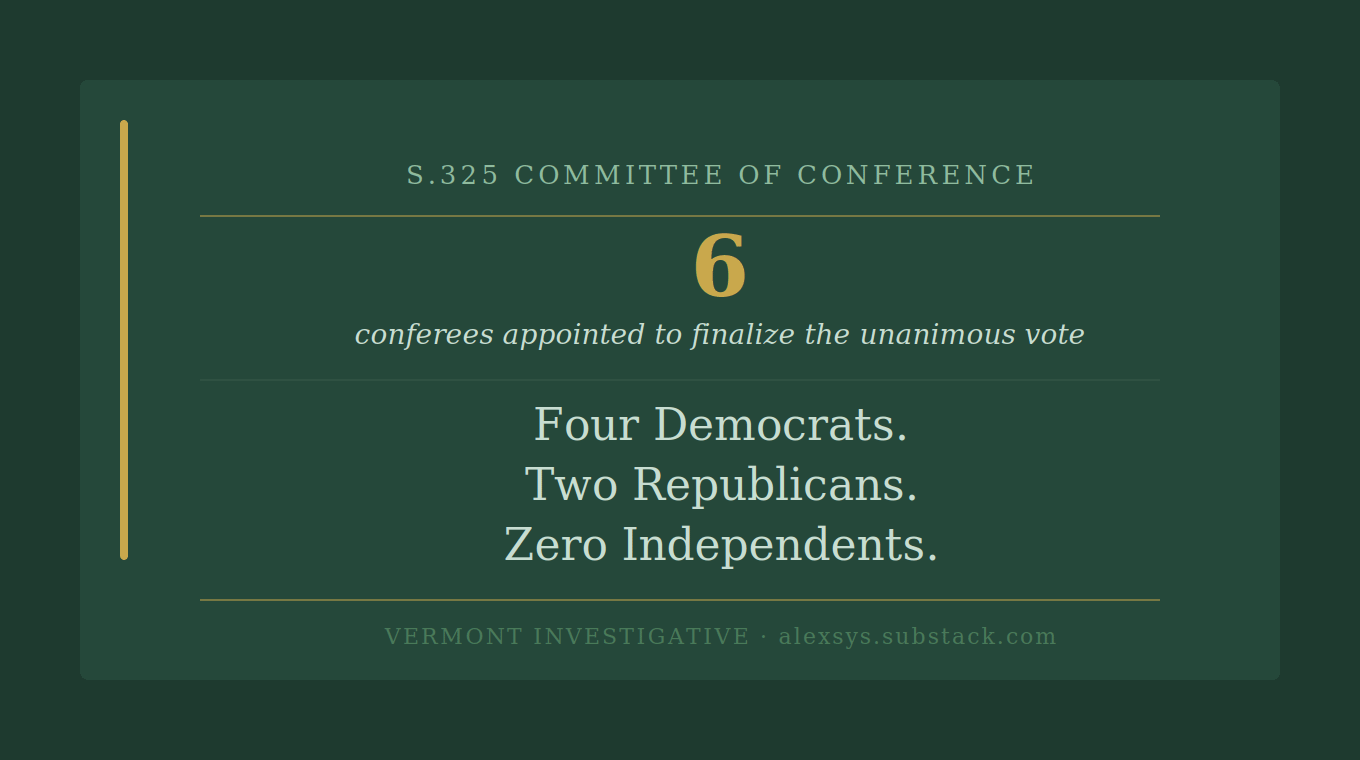
S.325 — the Act 181 repeal bill that passed the Vermont House unanimously — has moved to a Committee of Conference. Six legislators — three from the House, three from the Senate — will negotiate the final version of the bill. The meetings are open to the public. The session ends May 17.
On May 13, both chambers appointed their conferees. The full Committee of Conference for S.325 is now confirmed:
House: Reps. Sheldon of Middlebury (D), Labor of Morgan (R), and Chapin of East Montpelier (D).
Senate: Sens. Watson of Montpelier (D), Bongartz of Manchester (D), and Williams of Rutland (R).
Three Democrats. Two Republicans. Zero independents.
The bill that passed the Vermont House with Republican, Democratic, and independent votes — unanimously — will be finalized by three Democrats and two Republicans. The three Democrats — Sheldon, Chapin, and Watson — have each supported the process framework and the Act 59 planning approach throughout this session. The two Republicans — Labor of Morgan and Williams of Rutland — are both farmers from rural Vermont whose constituencies align directly with the working landowners at the center of this fight.
A unanimous floor vote does not guarantee a unanimous outcome in conference. The Vermont Investigative series will report on the Committee of Conference proceedings as they develop. The meetings are open to the public.
The Act 59 conservation plan is due back to the legislature. VHCB has committed on the record that UVA will be counted as durably protected toward the 50x50 goal. That commitment is now public, documented, and attributable. If the plan does not reflect it, the record will show the gap between what was promised and what was delivered.
The Vermont Investigative series will be watching.
VERIFIED: Roll call records, Vermont Legislature, H.70, February 5 and May 12, 2026. VHCB statement, Waterbury Roundabout, May 11, 2026. Golden Dome SmartTranscripts, House Environment Committee, February 27 and March 11, 2026. Vermont Legislature, Committees of Conference, 2025-2026 session.
H.70 failed. The coalition grew. The plan is not a law. The transcript is public. The pattern is documented.
Vermont’s working landowners have kept 2.5 million acres intact, productive, and ecologically connected — for generations, without a conservation easement, without a line in the official inventory, and without a statute that counts what they have already done.
VHCB says that is about to change.
A promise is not a law. A plan is not a statute. And the people who have been doing the work are still waiting to be counted.
Data tells stories. Patterns show convergence. Curiosity validates both.
Alexsys Thompson is an investigative journalist and consciousness-based leadership coach.
Vermont Investigative is published at alexsys.substack.com