
Digging Into Act 59, Part 2
The grant program, the focal areas, and the questions the public record has opened

A grant program and a statutory goal
In January 2025 The Nature Conservancy in Vermont launched the Vermont Biodiversity Protection Fund — a private grant program distributing up to $100,000 per project to land trusts, municipalities, and state agencies for land acquisition and conservation easement projects across Vermont.
The fund’s stated purpose appears in TNC Vermont’s own press release: “To meet the State’s goal of conserving 30% of land by 2030, we must work together, and quickly.”
That goal — 30% by 2030 — is Act 59. The same law whose findings name the Staying Connected Initiative, whose goals embed Vermont Conservation Design three times in statute, and whose planning process TNC participated in as a named lead implementer in the Vermont Conservation Plan Draft Expanded Framework Report published January 2026.
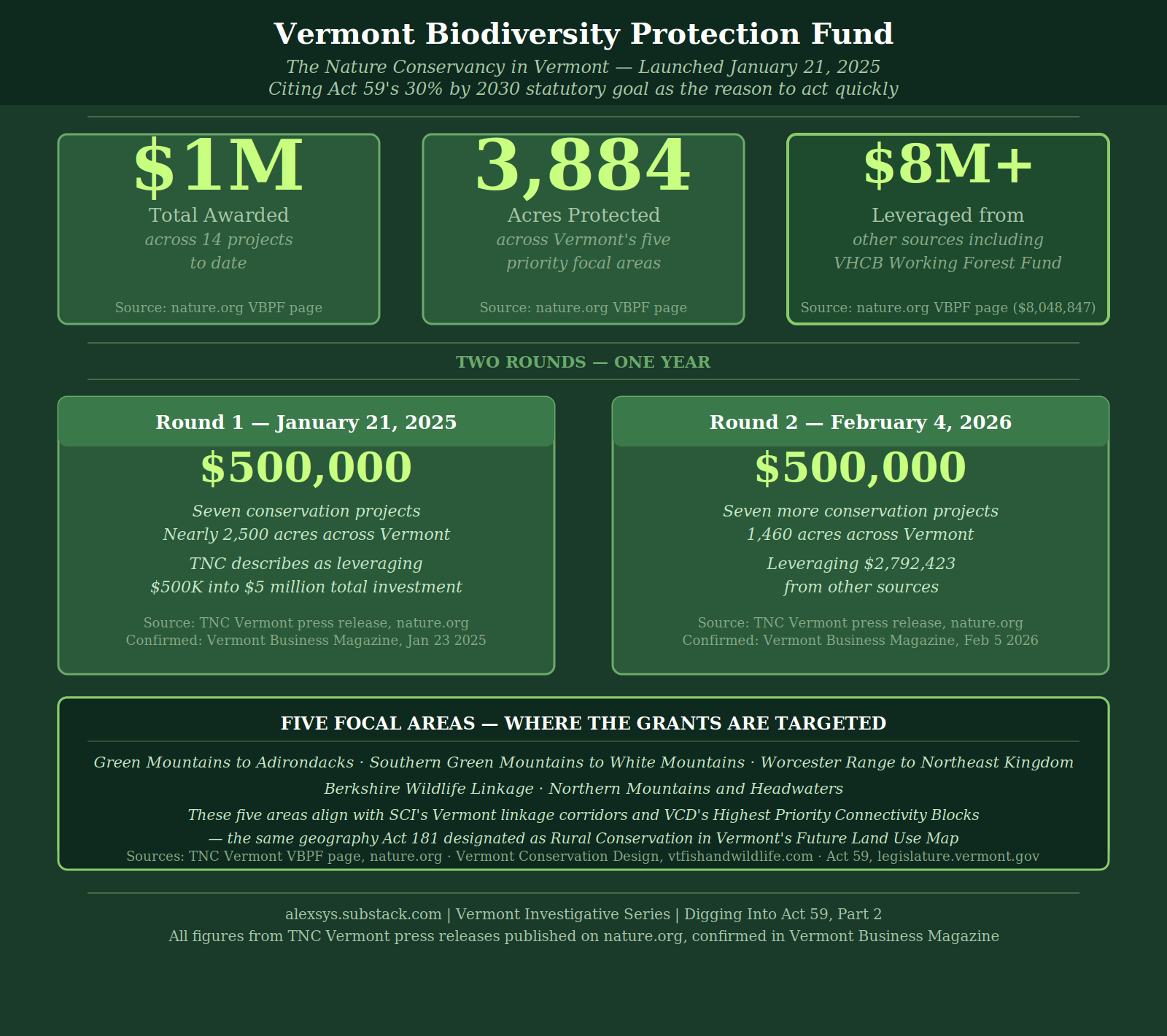
To date the Vermont Biodiversity Protection Fund has awarded $1 million across 14 projects protecting 3,884 acres — leveraging $8,048,847 from other sources. The fund launched January 21, 2025 with an initial $500,000 round awarding grants to seven projects totaling nearly 2,500 acres. A second round in February 2026 awarded another $500,000 to seven more projects protecting 1,460 acres. Additional rounds are planned. Both rounds are documented in TNC Vermont press releases published on nature.org and confirmed in Vermont Business Magazine
Both rounds are documented in TNC Vermont press releases published on nature.org and confirmed in Vermont Business Magazine.
The fund’s urgency language is notable. Act 59’s 30% by 2030 goal carries a statutory deadline — the same deadline embedded in the bill’s one-year inventory requirement. The compressed timeline that drove Vermont’s conservation planning process, documented in Vermont’s Conservation Plan Is Being Written — Part XV of this series — is the same timeline TNC’s grant program now cites as the reason to act quickly.
Five focal areas
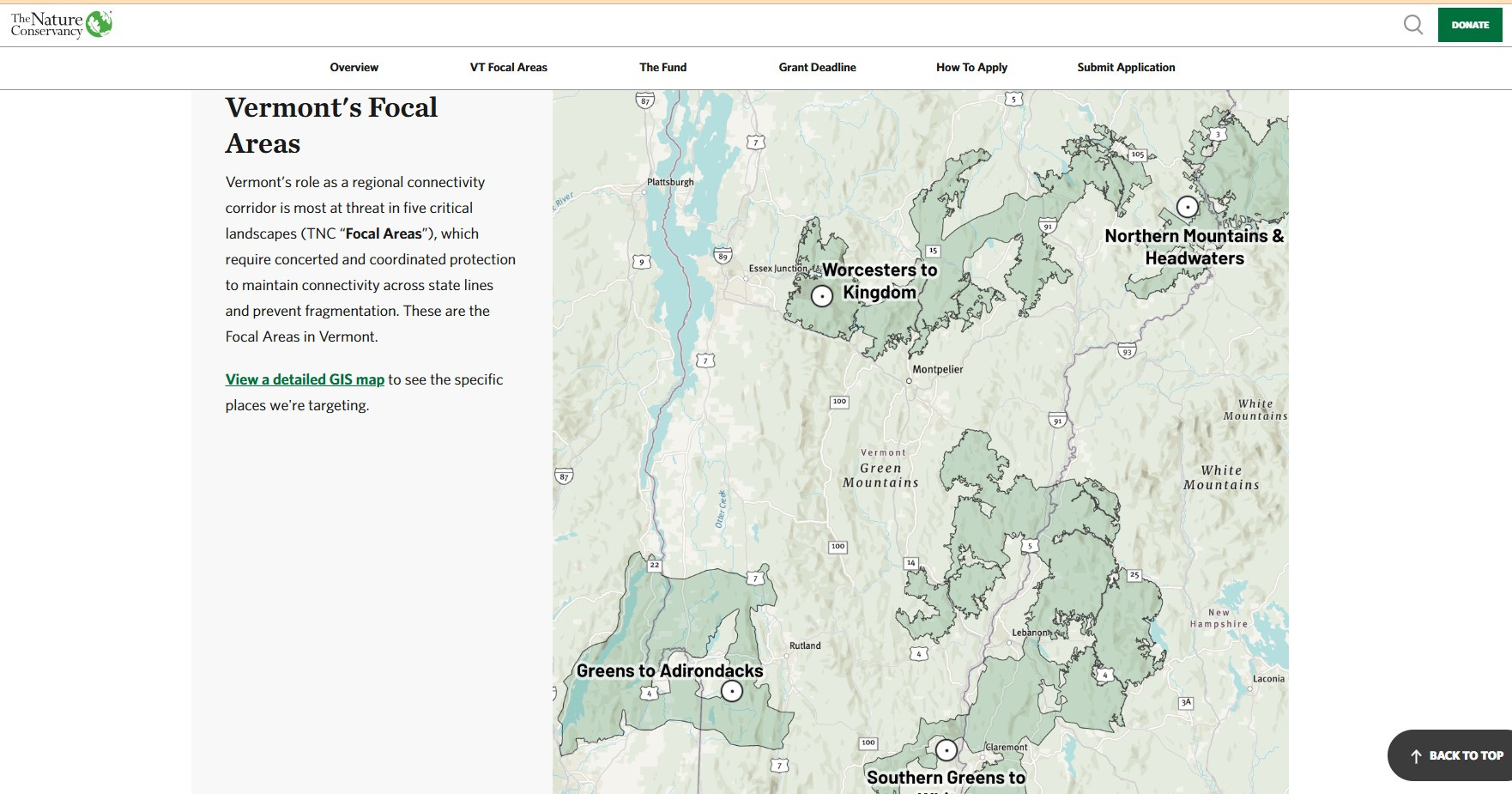
TNC Vermont prioritizes the fund’s grants within five landscapes it calls Focal Areas — areas it describes as the most critical for biodiversity protection and species migration in Vermont:
Green Mountains to Adirondacks
Southern Green Mountains to White Mountains
Worcester Range to Northeast Kingdom
Berkshire Wildlife Linkage
Northern Mountains and Headwaters
These are not new designations. They are the Vermont portions of the Staying Connected Initiative’s nine regional linkage corridors — the same corridors named as a legislative finding in Act 59’s Section 2(11), documented in Digging Into Act 59, Part 1. They are the same geography that Vermont Conservation Design identified as Highest Priority Connectivity Blocks in its 2015 and 2018 technical reports. They are the same geography that Vermont Conservation Design identified as Highest Priority Connectivity Blocks — the same VCD data that Act 181 used to build its Future Land Use Map Rural Conservation designations
The Rural Conservation designation survived S.325’s partial repeal in May 2026. LURB Chair Janet Hurley confirmed on the record that the RC designation remains embedded in regional plans.
The science identified the corridors. The law designated them. A private grant program now funds the conservation of land within them.
The chain
Digging Into Act 59, Part 1 documented the chain from science product to statute. Part 2 adds the next layer.
Here is what the public record shows, each statement sourced to a primary document:
TNC is the Staying Connected Initiative's primary fiscal sponsor and coordinator — documented on Highstead.net
TNC staff contributed to the development of Vermont Conservation Design — documented in the VCD Part 2 technical report, March 2018.
Act 59 embedded VCD three times in statute as the guide for Vermont’s conservation goals — documented in Act 59’s statutory text at legislature.vermont.gov.
TNC Vermont is a registered lobbyist before the Vermont legislature — documented in the Vermont Secretary of State’s lobbyist registry.
TNC Vermont is named as a lead implementer in the Vermont Conservation Plan — documented in the Draft Expanded Framework Report, January 2026
Act 181 built its Future Land Use Map Rural Conservation designations directly on VCD’s Highest Priority Connectivity Blocks — confirmed on the record by LURB Chair Janet Hurley, 2026.
TNC Vermont launched the Vermont Biodiversity Protection Fund in January 2025 to fund conservation projects in the same five landscapes — documented in TNC Vermont press releases published on nature.org.
Each of those statements is sourced to a primary document listed at the bottom of this piece. The public record documents structure. It does not document intent. The people and organizations involved in this work have genuine conservation records. The ecological concerns motivating this work are real.
What this series is pursuing next
The public record has opened the following questions. This series is actively researching each one. If you have documents, firsthand knowledge, or experience relevant to any of them you can reach me directly.
1. Who funds the Vermont Biodiversity Protection Fund? TNC Vermont has distributed $1 million in Vermont since January 2025. What are the funding sources behind it? TNC’s consolidated financials do not break out Vermont program revenue independently.
2. Is the geographic overlap between TNC’s focal areas, VCD’s priority blocks, and the FLUM Rural Conservation designations the result of coordinated planning — or the inevitable outcome of all three being built on the same underlying science? The geography is substantially identical across three institutional layers. Understanding whether that convergence was designed, discussed, or simply inherited from the same data source matters for how Vermont’s conservation plan is evaluated going forward.
3. What coordination exists between VHCB and TNC Vermont on projects that may receive funding from both? VHCB administers Vermont’s Act 59 conservation planning process and names TNC as a lead implementer in the Vermont Conservation Plan. VHCB’s Working Forest Fund is listed as an eligible matching source for Vermont Biodiversity Protection Fund projects. What protocols govern coordination between the two organizations?
4. When state employees contribute to science products that become statutory frameworks — and those frameworks generate private grant programs implementing the same science — what governance protocols govern that relationship? Vermont Conservation Design was built by state employees working alongside conservation organization partners using federal wildlife grant funding. It became the statutory framework for Act 59 without a public comment process specific to that regulatory use. The organizations whose staff contributed to building it are now implementing the plan built on it.
5. What did the Vermont legislature know about SCI’s relationship to TNC when it named SCI as a legislative finding?
Legislative findings routinely cite external science and organizations without disclosing their funding relationships. That is standard practice. A finding that names an organization is not required to disclose who funds it.
What makes this question worth asking is the combination of facts in the public record.
Act 59’s Section 2(11) names the Staying Connected Initiative as a legislative finding — part of the factual basis for the law. TNC is SCI’s primary fiscal sponsor and coordinator, documented on Highstead.net. TNC Vermont lobbied for Act 59, documented in the Vermont Secretary of State’s lobbyist registry. TNC Vermont’s Director of External Affairs testified in support of related legislation before the Vermont legislature, documented in the committee hearing record.
SCI is not a passive science organization. Its own website describes two explicit strategic goals: promoting and supporting government action on connectivity and supporting local action for conservation through direct technical assistance to municipalities and regional planning commissions. SCI’s website states the partnership has helped secure meaningful improvements in the land use plans and policies of nearly 20 communities and three regional planning commissions.
In other words: the organization named as a legislative finding in Act 59 explicitly pursues policy development and local land use planning as core strategies. Its primary fiscal sponsor and coordinator lobbied for the bill that named it. Whether the legislature was aware of that combination of relationships when it adopted SCI’s corridor science as a statutory finding is not documented in the public record reviewed for this series.
That is not an accusation. Legislative findings are informed by testimony, advocacy, and relationships — that is how policy is made. The question is whether the full structure was visible to the legislators who voted on it, and to the Vermonters whose land use plans it now shapes.
6. What process, if any, was considered for public vetting of Vermont Conservation Design before its statutory embedding? VCD was developed with federal wildlife grant funding and embedded in Act 59 as the statutory guide for planning the conservation of half of Vermont’s land. It was not subject to a public comment process specific to that regulatory use. Whether any such process was considered — and why it did not occur — is not documented in the public record reviewed for this series.
7. Act 59’s one-year statutory inventory deadline created the urgency that drove Vermont’s compressed conservation planning process. TNC Vermont’s grant program now cites the same statutory deadline as the reason to act quickly. Was the statutory timeline designed with the expectation that it would accelerate private conservation investment in the designated landscapes — and if so, by whom and through what process?
The Vermont Conservation Plan is due to the legislature by June 2026.
The public record documents the following: TNC is SCI’s primary fiscal sponsor. TNC staff contributed to Vermont Conservation Design. TNC Vermont lobbied for Act 59. TNC Vermont is named as a lead implementer in the Conservation Plan. TNC Vermont launched a private grant program in January 2025 funding conservation in the same landscapes. Each of those statements is sourced to a primary document listed below.
The plan will determine what comes next. These are the questions the public record has opened. They are yours to ask too.
TNC Vermont has been notified of this publication as a courtesy and is welcome to respond. Factual corrections will be incorporated promptly.
If you have documents or firsthand knowledge relevant to any of these questions, contact me at alexsys.substack.com
Support this work at ko-fi.com/alexsysthompson
Primary Sources
Act 59 of 2023 (H.126) — legislature.vermont.gov
Vermont Conservation Design Summary Report, February 2018 — vtfishandwildlife.com
Vermont Conservation Design Part 2: Natural Communities and Habitats, March 2018
Staying Connected Initiative — stayingconnectedinitiative.org
Staying Connected Initiative Policy Development — stayingconnectedinitiative.org/what-we-do/policy-development
Staying Connected Initiative Land Use Planning — stayingconnectedinitiative.org/what-we-do/land-use-planning
TNC as SCI primary fiscal sponsor — Highstead.net, September 2024
Vermont Biodiversity Protection Fund launch announcement, January 2025 — nature.org
Vermont Biodiversity Protection Fund second round announcement, February 2026 — nature.org
Vermont Business Magazine coverage, January 2025 and February 2026 — vermontbiz.com
Vermont Conservation Plan Draft Expanded Framework Report, January 2026 — vhcb.org
Vermont Secretary of State lobbyist registry — sos.vermont.gov
S.325 House Calendar, May 6, 2026 — legislature.vermont.gov
Janet Hurley on-record confirmation, LURB Chair, 2026
Digging Into Act 59, Part 1 — alexsys.substack.com